November, 2024
Magnificent Milan
What a city! I don’t know where to stop in sharing this wonderful place so I apologize for the volume. And how lucky we were with blue skies and warm days at the end of October! Congratulations if you make it to the end of my post…
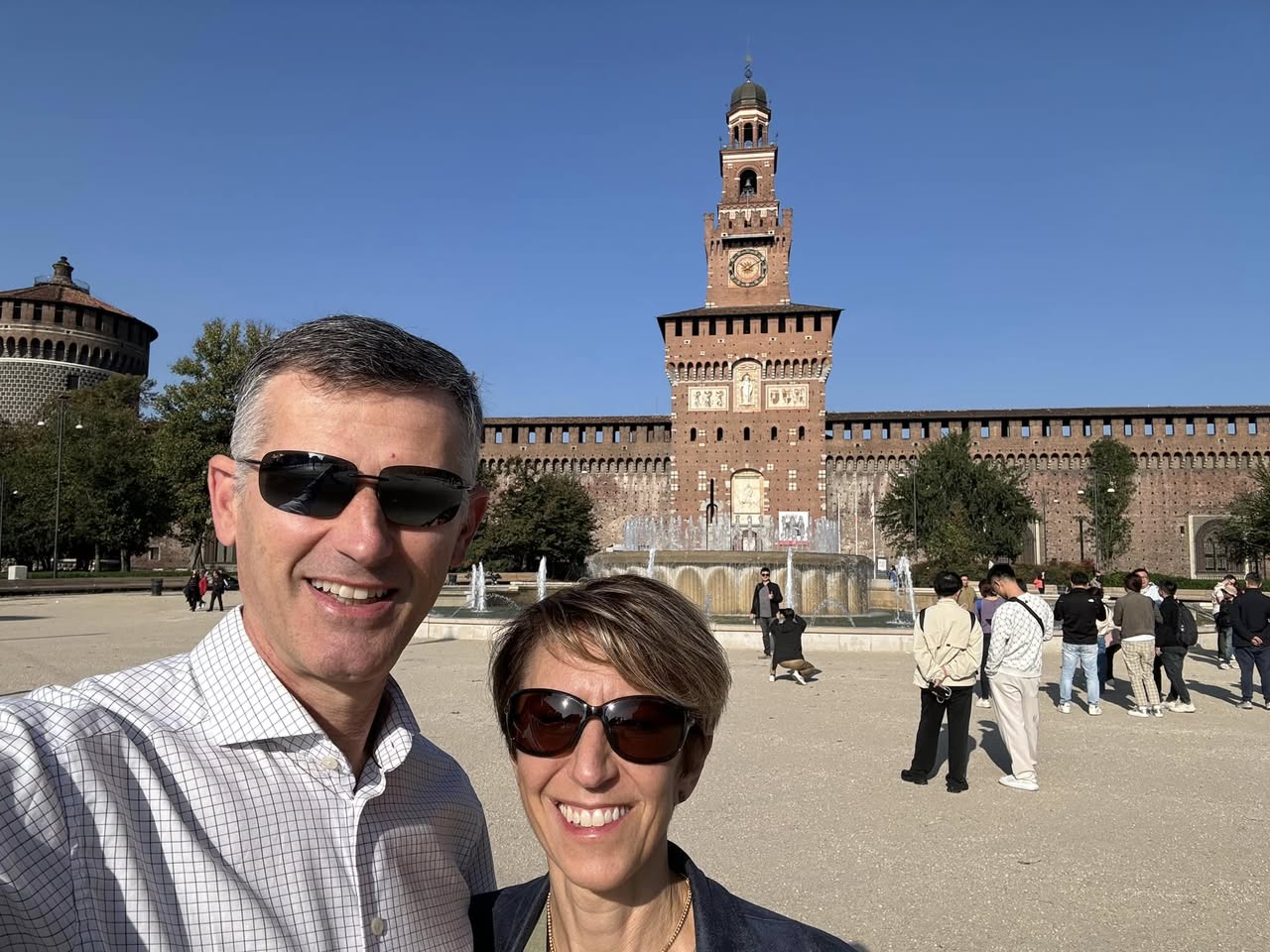
The Sforza Castle was built around 1360 by the Visconti family as a fortress with multiple layers, moats and drawbridges to prevent attacks. This didn’t manage to prevent the short-lived Ambrosian Republic from destroying much of it as a means of preventing enemies from moving in. Interesting wisdom…I guess they didn’t trust the intended defence systems in place. When Francesco Sforza married Filippo Visconti’s daughter, he managed to wiggle his way into the Dukedom when his father-in-law died (Filippo’s only legitimate heir, his daughter Bianca Maria Visconti, couldn’t legally take over because she wasn’t male). Needless to say, Francesco married well! He restored the castle not only as a fortress but a grand residence as well. Its interior now houses various historical and art galleries (Michelangelo’s final sculpture, the unfinished Pietà Rondanini is here) which were closed when we went. But the exterior is pretty fantastic!
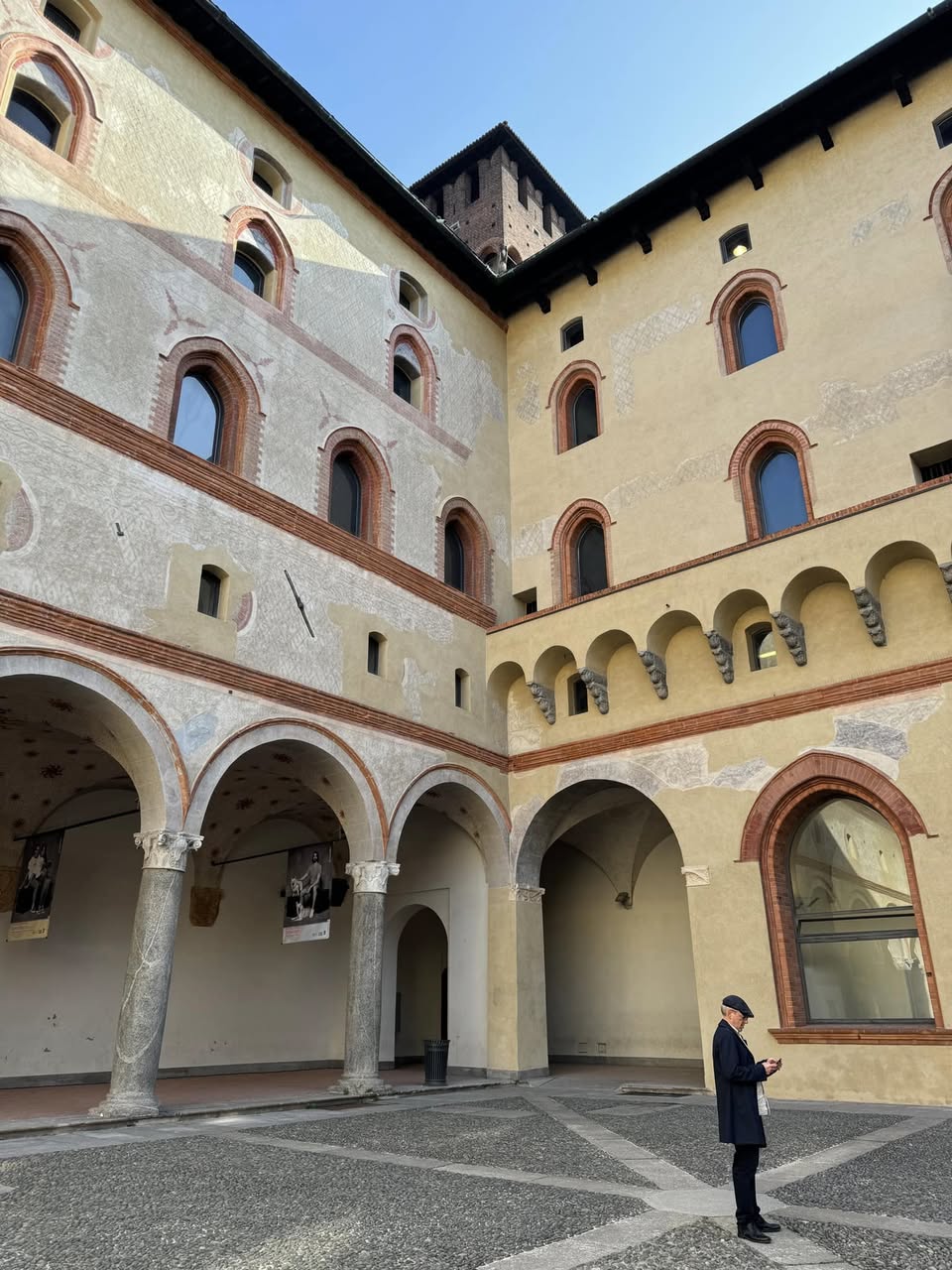
The Rocchetta was the castle's last defence in the event of invaders breaching the drawbridge over the “dead moat”…dead meaning not filled with water but it was still an obstacle with the benefit of less maintenance. This fellow seems to have found his way across the dead moat but he doesn’t look like he will pose much of a threat.
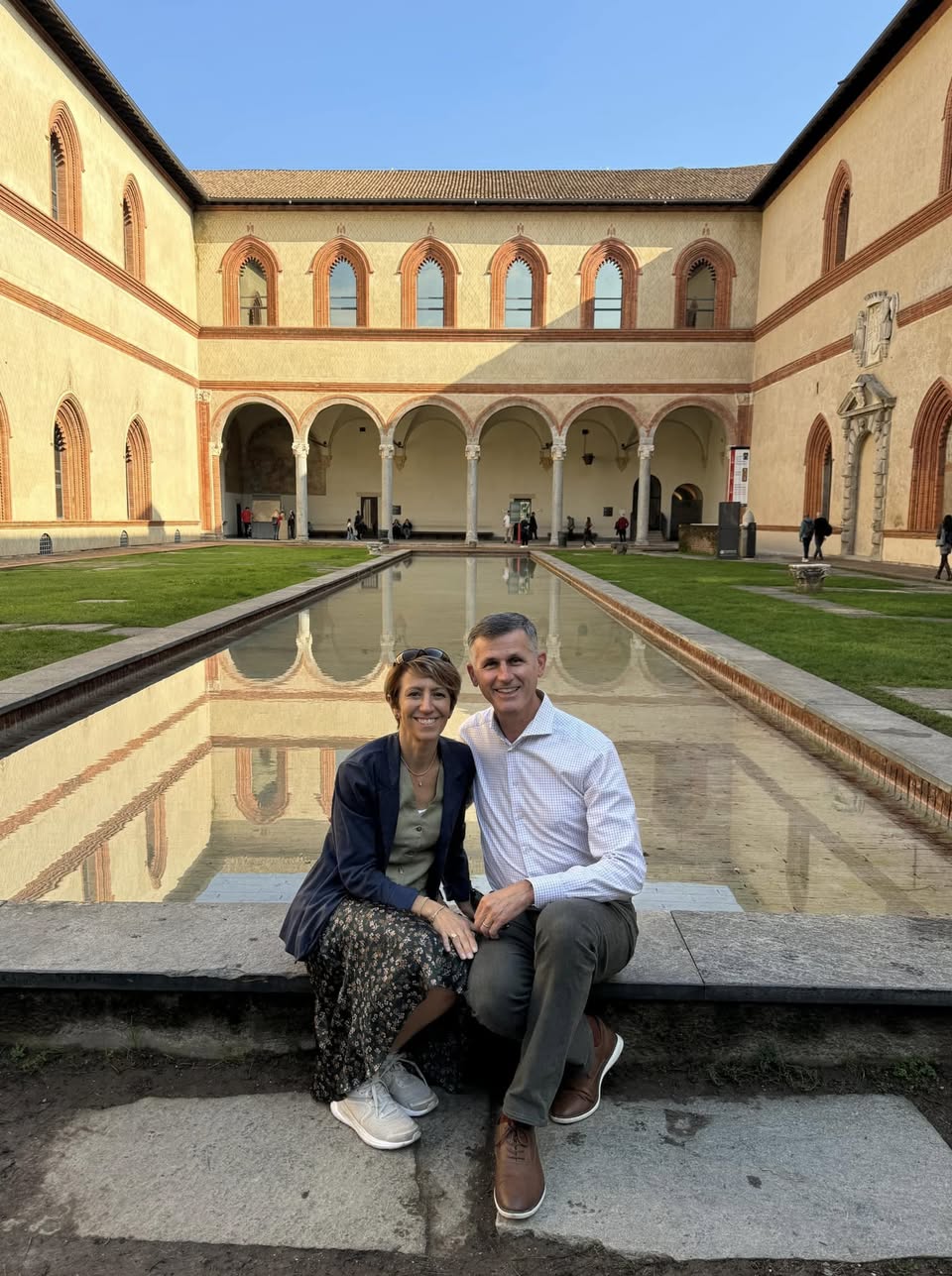
Ducal Courtyard of Sforza Castle was not just this stunning architectural feature; a lot of business happened out here. Royal ceremonies served to impress outsiders, judicial proceedings displayed the Sforza power, and various shenanigans around plots and conspiracies against the Sforza family showed just how treacherous Italian Renaissance politics was!
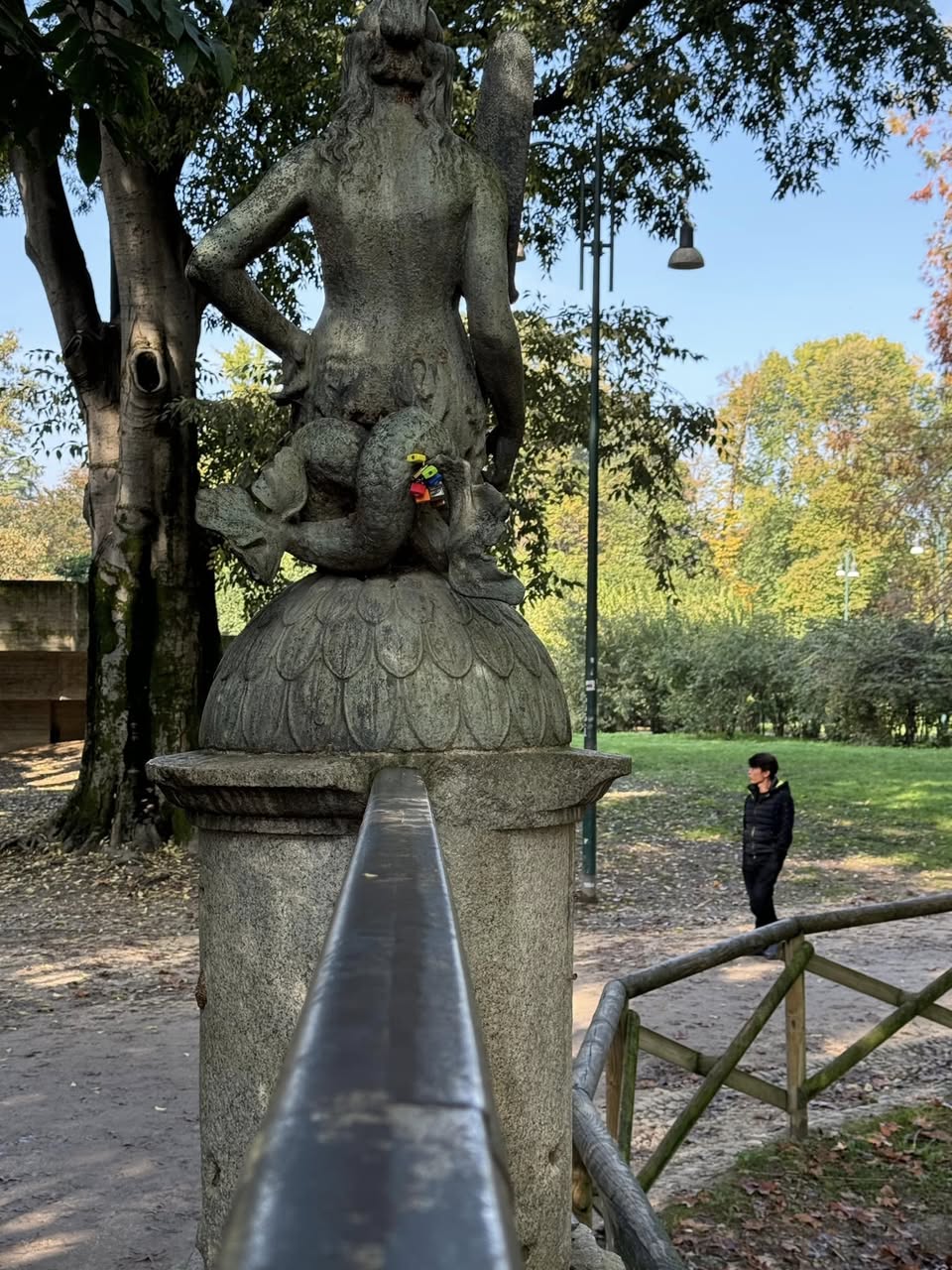
Interesting spot for Love Locks in the Parco Sempione outside the Sforza Castle.
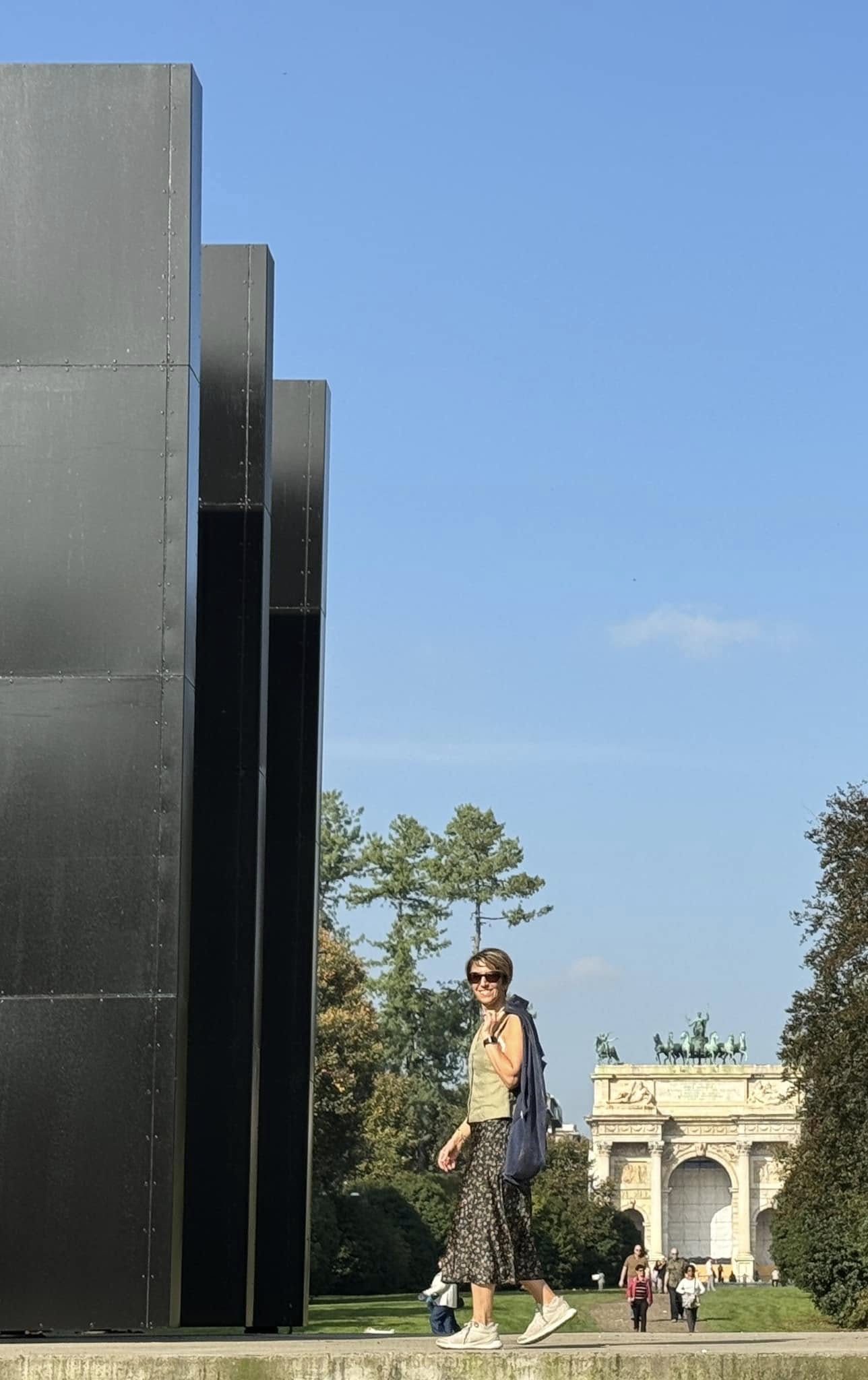
A little stroll across an open-air stage in the Parco Sempione.
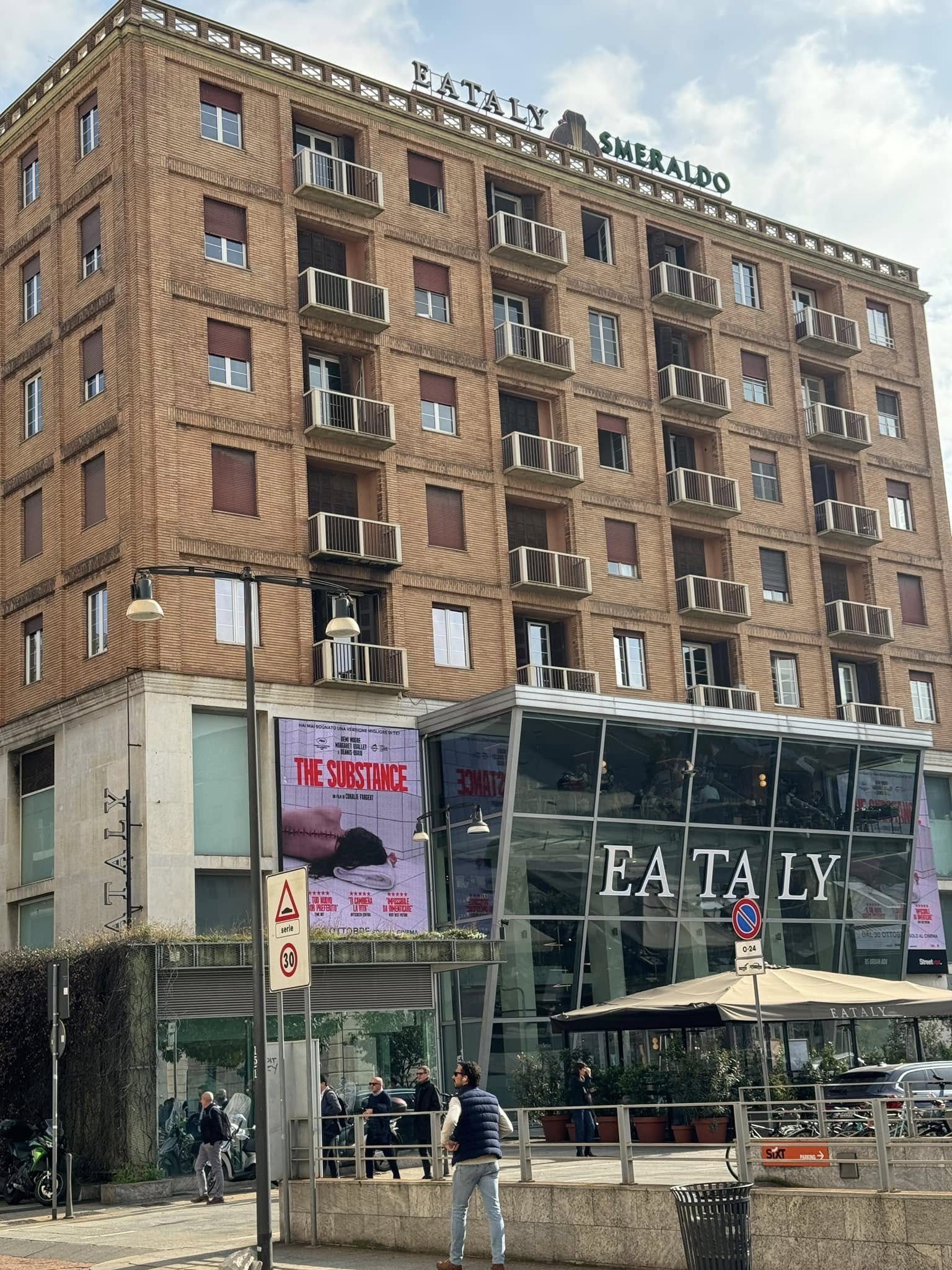
Seriously?! There’s an Eataly in Milan?! No wonder it’s empty…
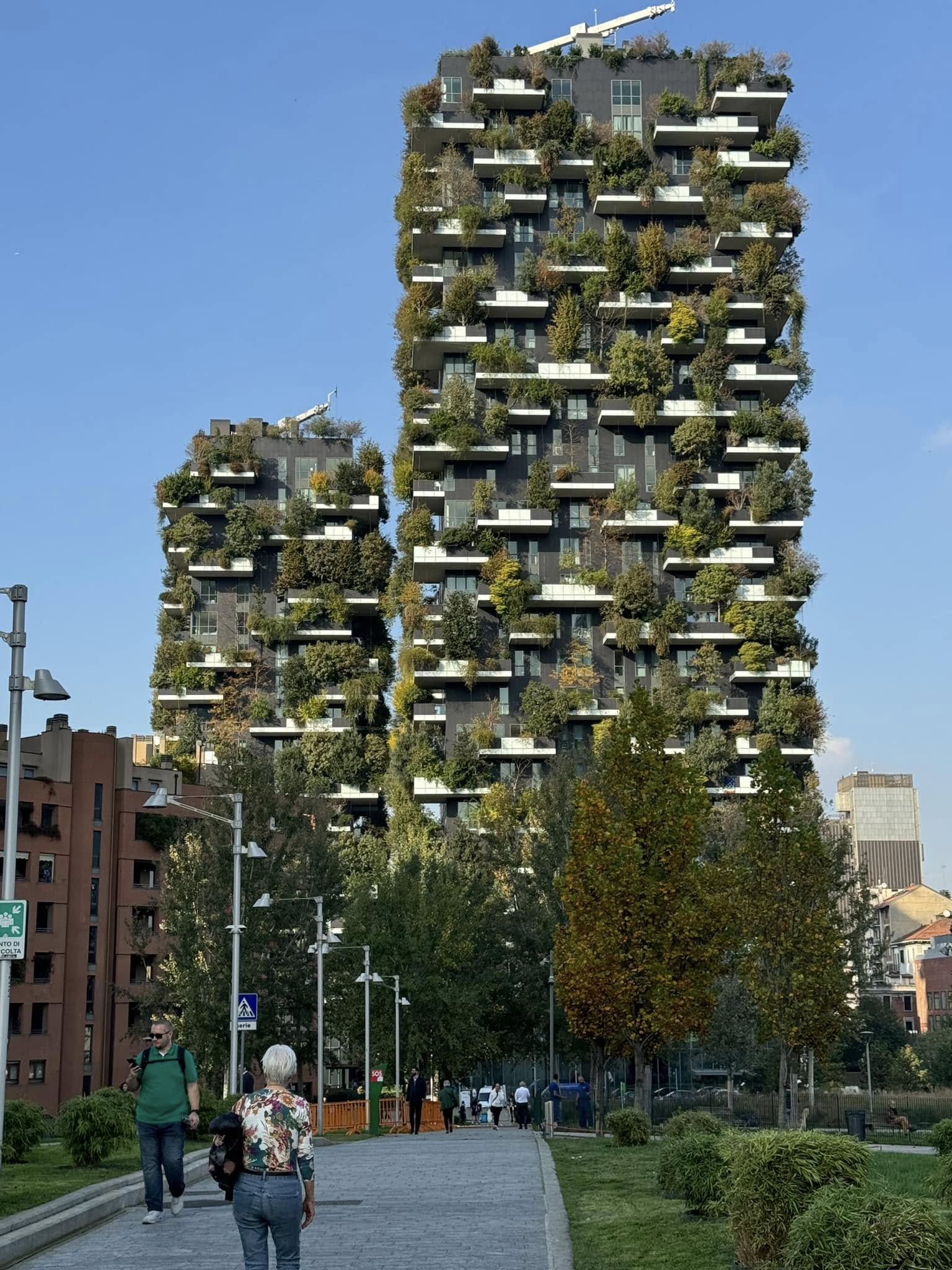
Milan’s Bosco Verticale (Vertical Forest) is a pair of 18- and 26-storey apartment buildings covered with nearly 800 trees, 4,500 shrubs, and 15,000 plants. Credit goes to architect Stefano Boeri for creating a brilliant example of eco-friendly design that looks amazing while absorbing CO2, improving air quality, enhancing biodiversity by attracting birds and insects to the urban landscape, and providing natural insulation for the apartments. Fortunately, these plants are not the responsibility of the tenants. Condo fees pay for a team of specialized arborists and gardeners who monitor plant health, prune, water, and ensure that each species thrives in its designated location on the building.
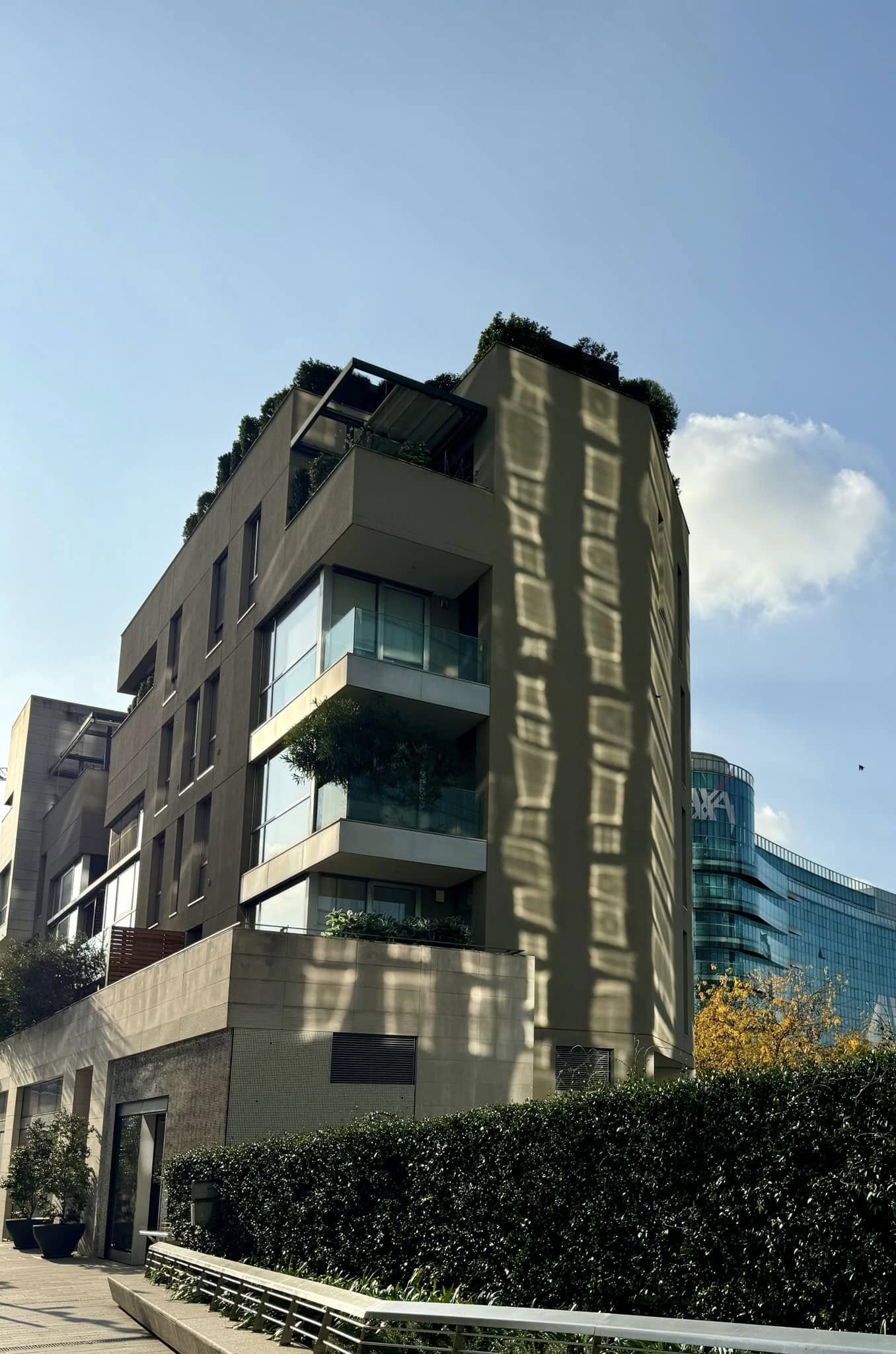
Who needs windows when you can borrow the reflection from the building next door.
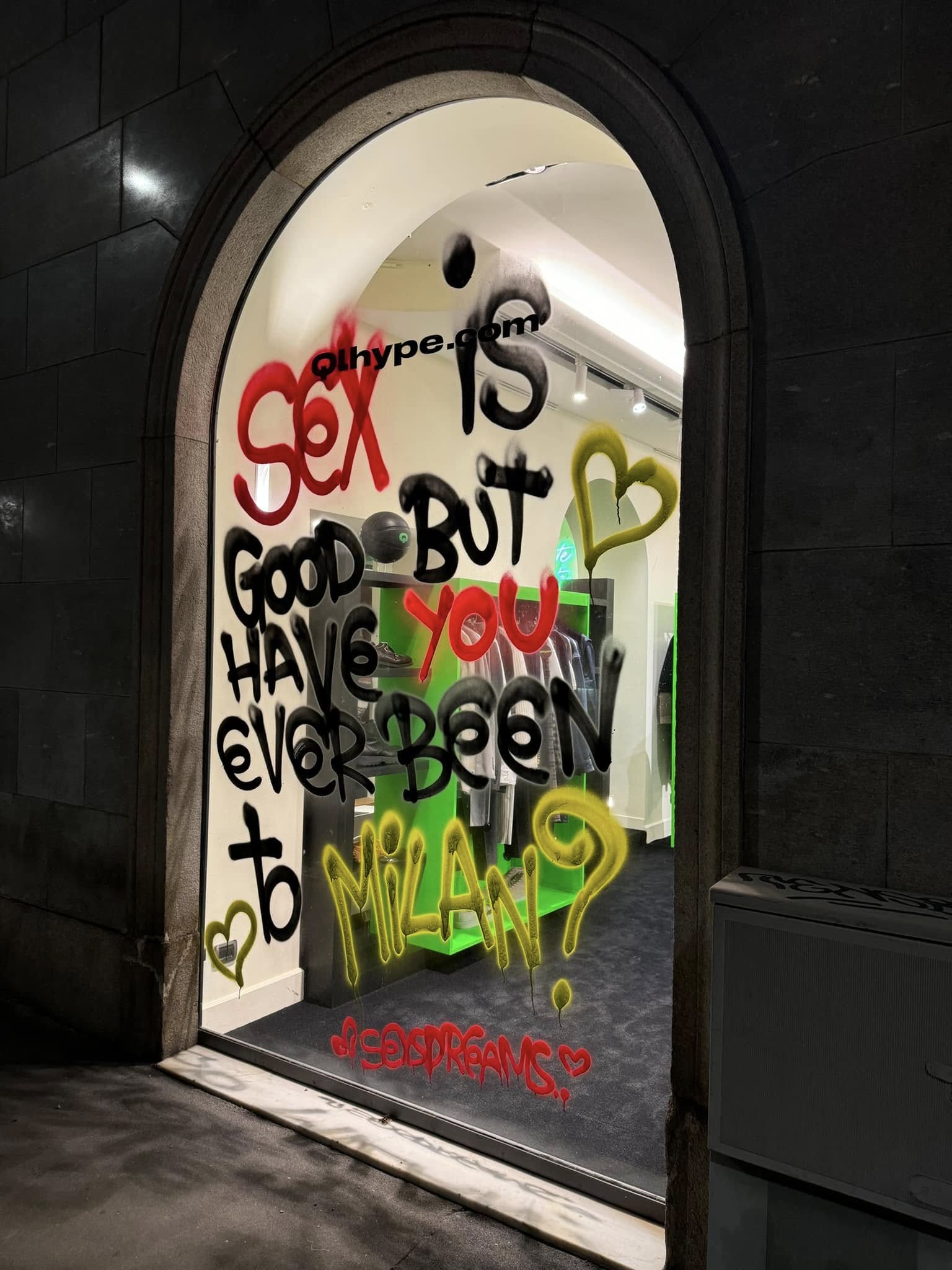
Enough said!
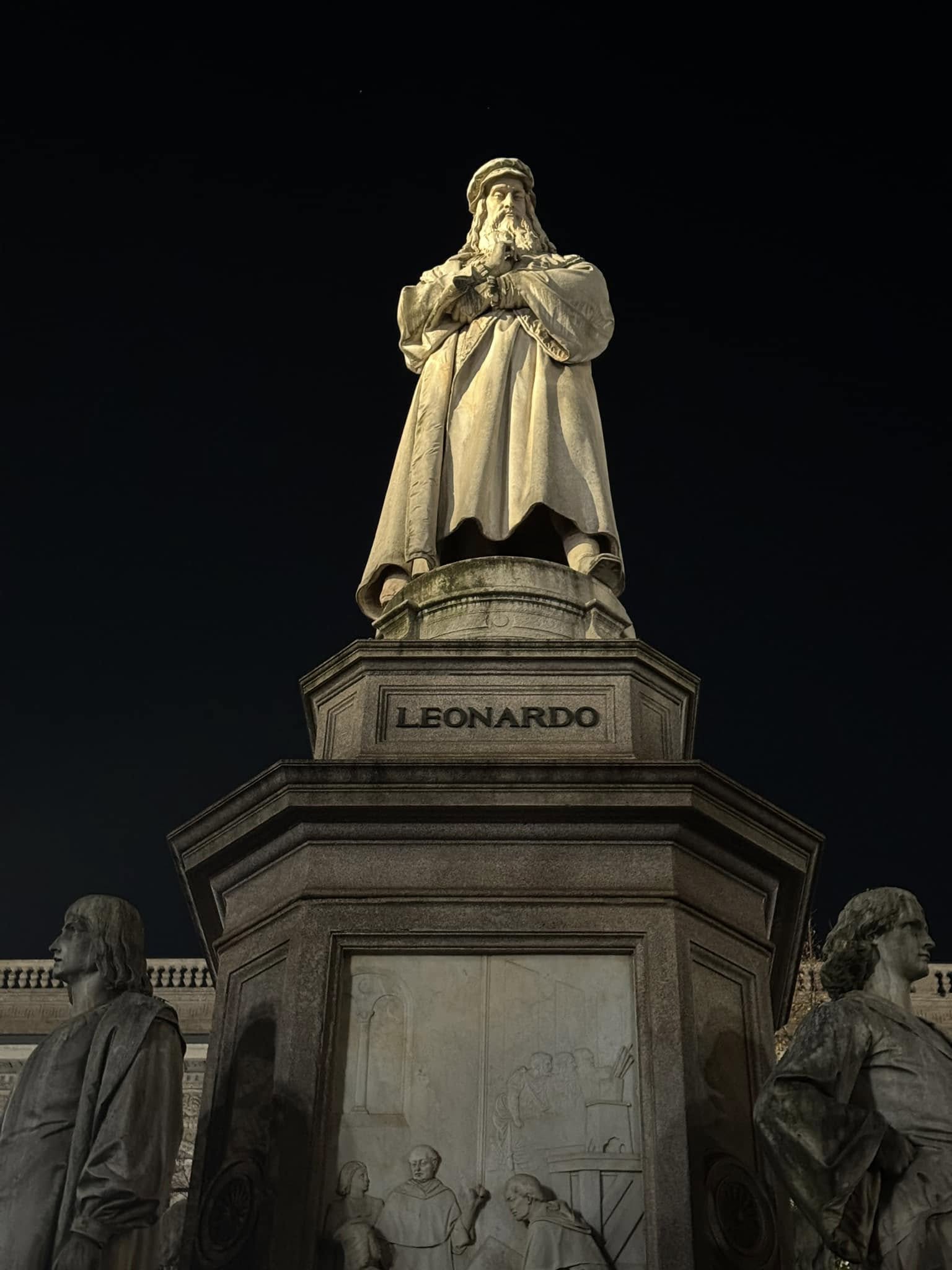
Who else but Leonardo has a statue in Milan! He spent 27 years here, honing his artistic, engineering, scientific and architectural skills. He left behind a rich legacy including The Last Supper and lots of work for the Sforzas.
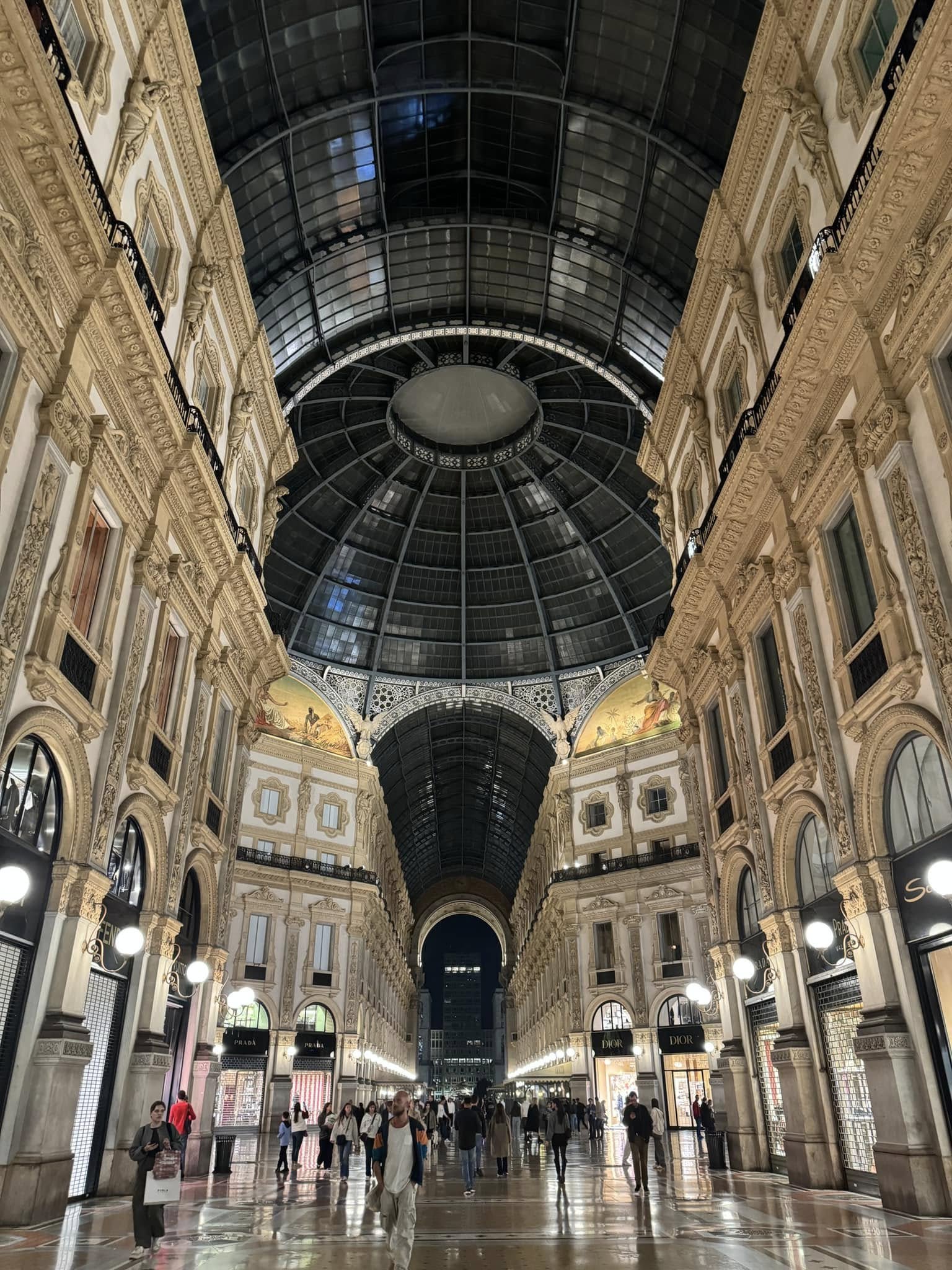
The Galleria Vittorio Emanuele II is a stunning shopping arcade beside Milan’s Duomo. It was groundbreaking architecture in its day (built between 1865 and 1877 by Giuseppe Mengoni) for its soaring iron-and-glass vaulted roof and central octagonal dome. Its nickname is “Il Salotto di Milano” (the Living Room of Milan) because it’s a hopping social and cultural gathering place all day and night.
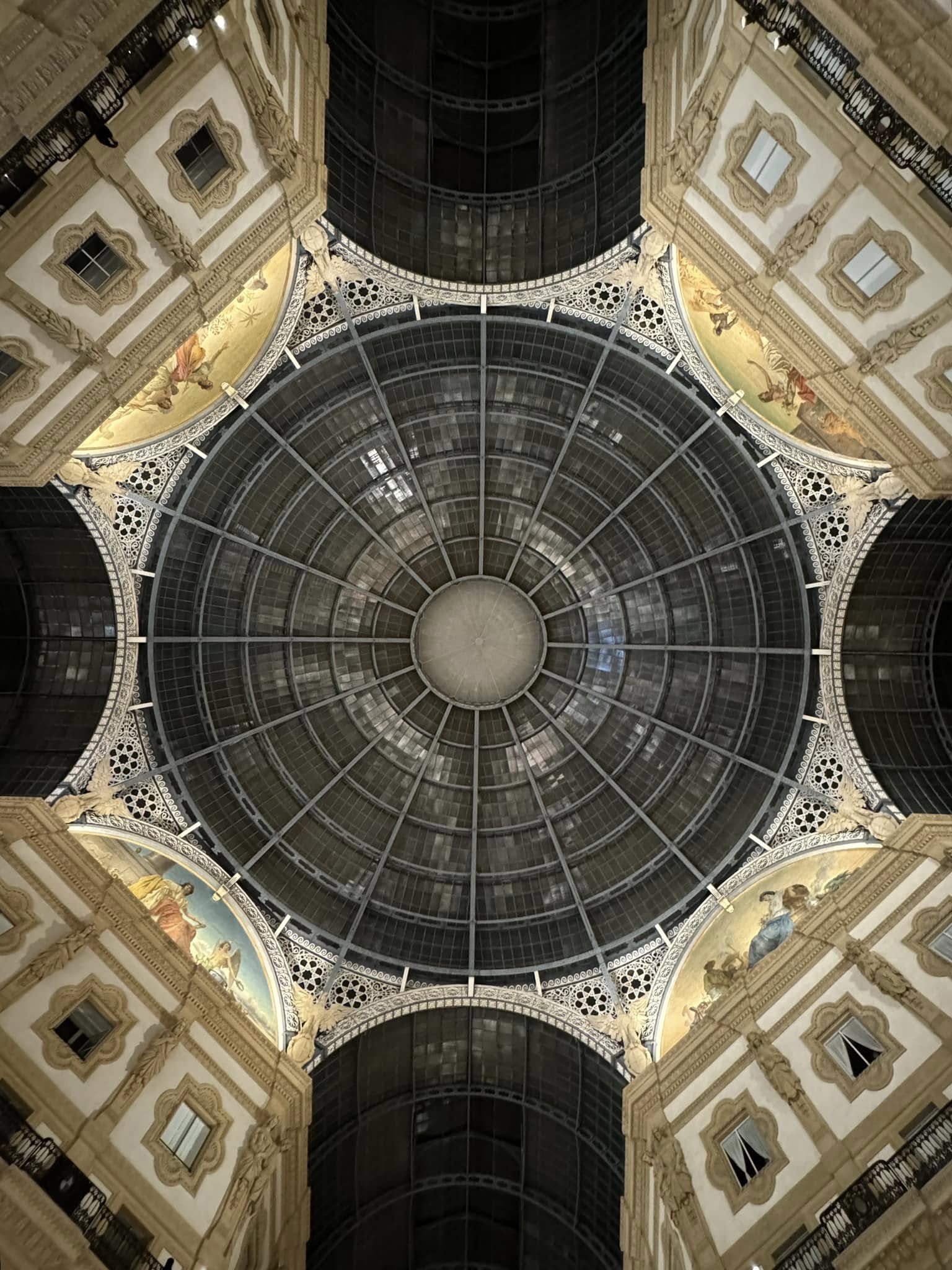
The dome!
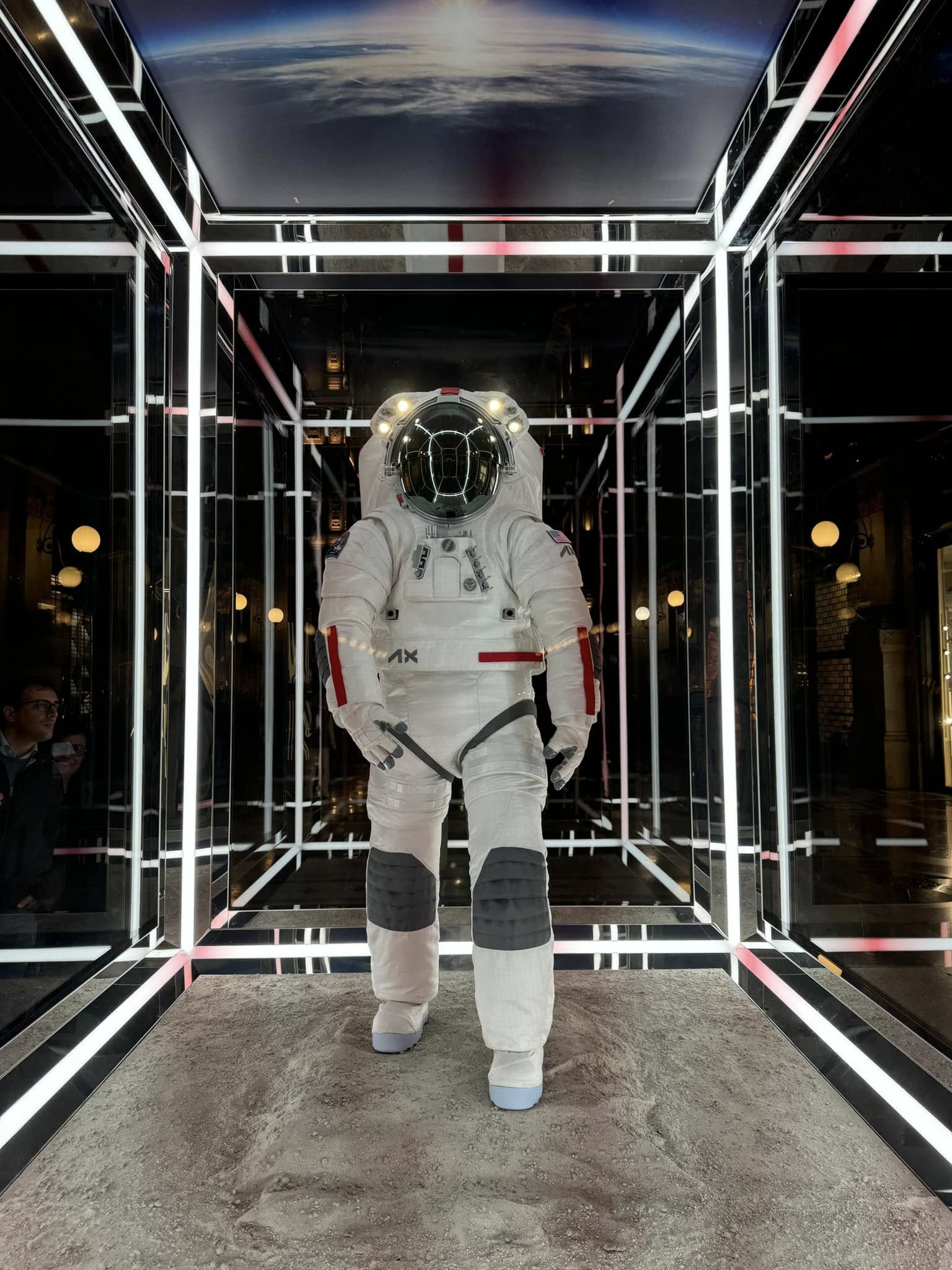
Along with all the big luxury fashion brands (Gucci, Louis Vuitton etc) Prada has placed its spacesuit designed in partnership with Axiom Space outside its flagship store here in the Galleria. We often think of these luxuries as little more than creative expensive stuff that has little impact on the world. In fact, the engineers and designers at fashion houses like Prada have such an in-depth knowledge and expertise in materials, manufacturing techniques and design that they are well-positioned to work alongside Axiom to create the best and safest suit for astronauts…that’s pretty impactful beyond the runway.
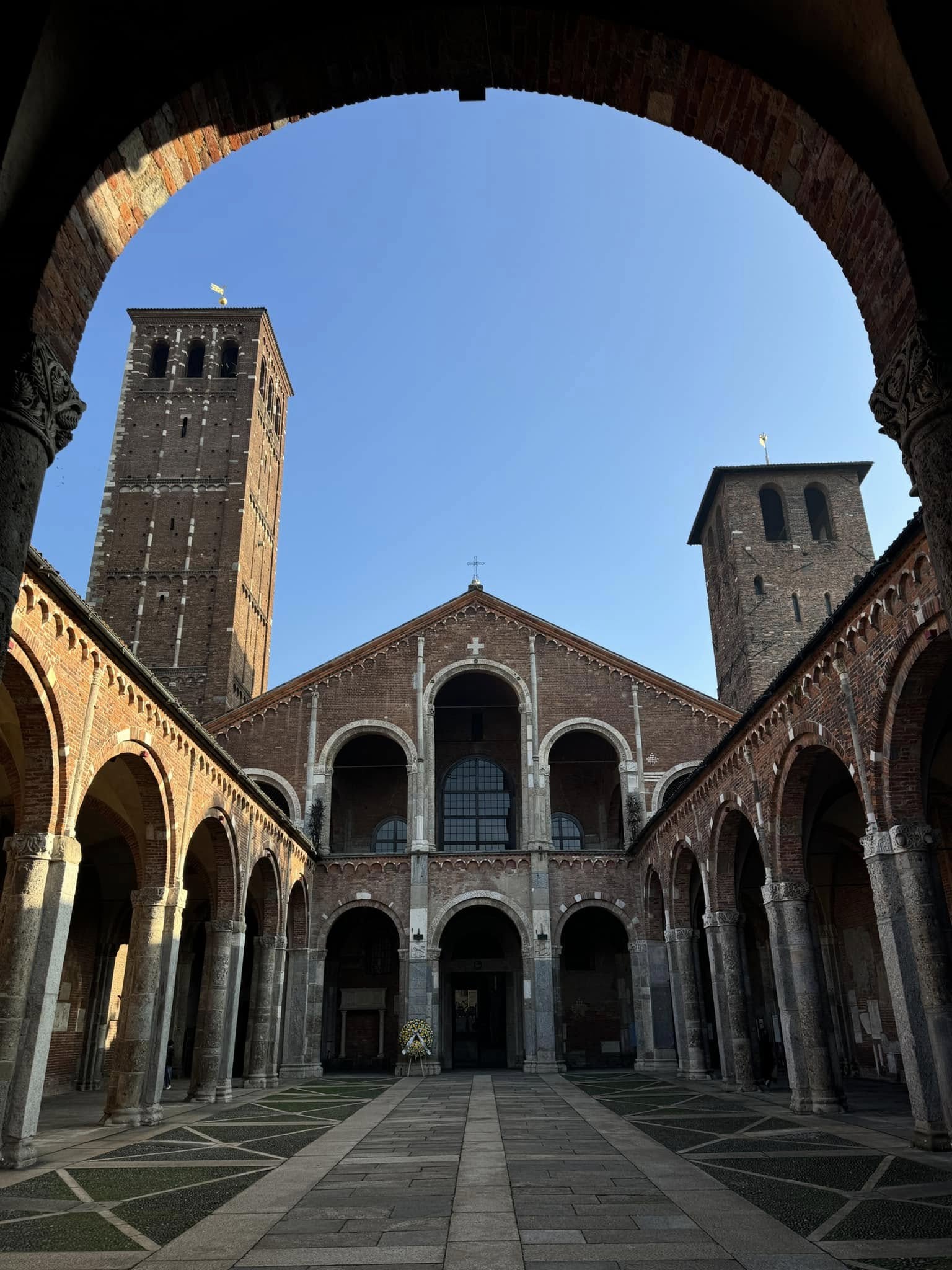
The Basilica di Sant’Ambrogio (379-386) was one of the earliest basilicas in Milan. Bishop Ambrose was the disruptor of his time, pushing against the accepted position of Emperors as divine rulers of all matters, including religious ones. Ambrose was a proponent of separating church and state and believed that Jesus and God were divine equals (Nicene Christianity) at a time when Rome pushed Arianism which believed Jesus was subordinate to his dad. Needless to say, Nicene Christianity won. Funnily enough, for someone who fought for the separation of church and state, Ambrose actually came to Milan as a Roman governor with a fancy title, but took over as Bishop when the existing Arian bishop of Milan died. So impressed were the people of Milan with him as governor, he was quickly baptized, ordained, and consecrated, all within a week. He was bishop for 23 years until his death and was named Patron Saint of Milan for his enormous impact on the city and Christianity.
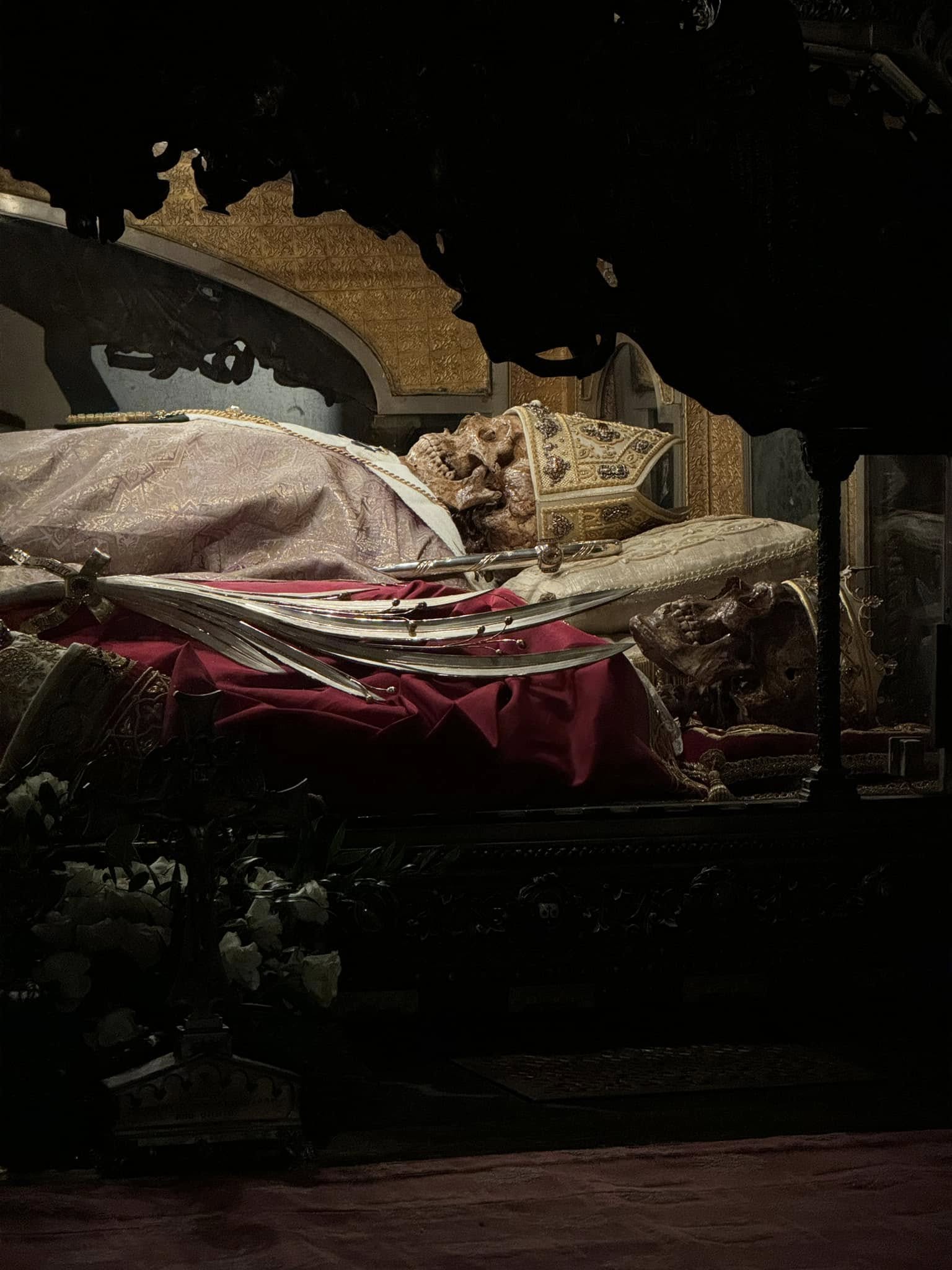
Ambrose built the Basilica with a view to it ultimately being his tomb (and named for him) but near the end of construction, the remains of Gervasius and Protasius were discovered — Milanese martyrs who died under Roman persecution. He decided to consecrate the basilica to them as the Basilica Martyrum; he personally disinterred their remains and buried them under the altar of his basilica in the tomb lined with precious marble which he intended to be his own resting place. When Ambrose died, the basilica was renamed and he joined Gervasius and Protasius in the crypt where the three of them lie together to this day.
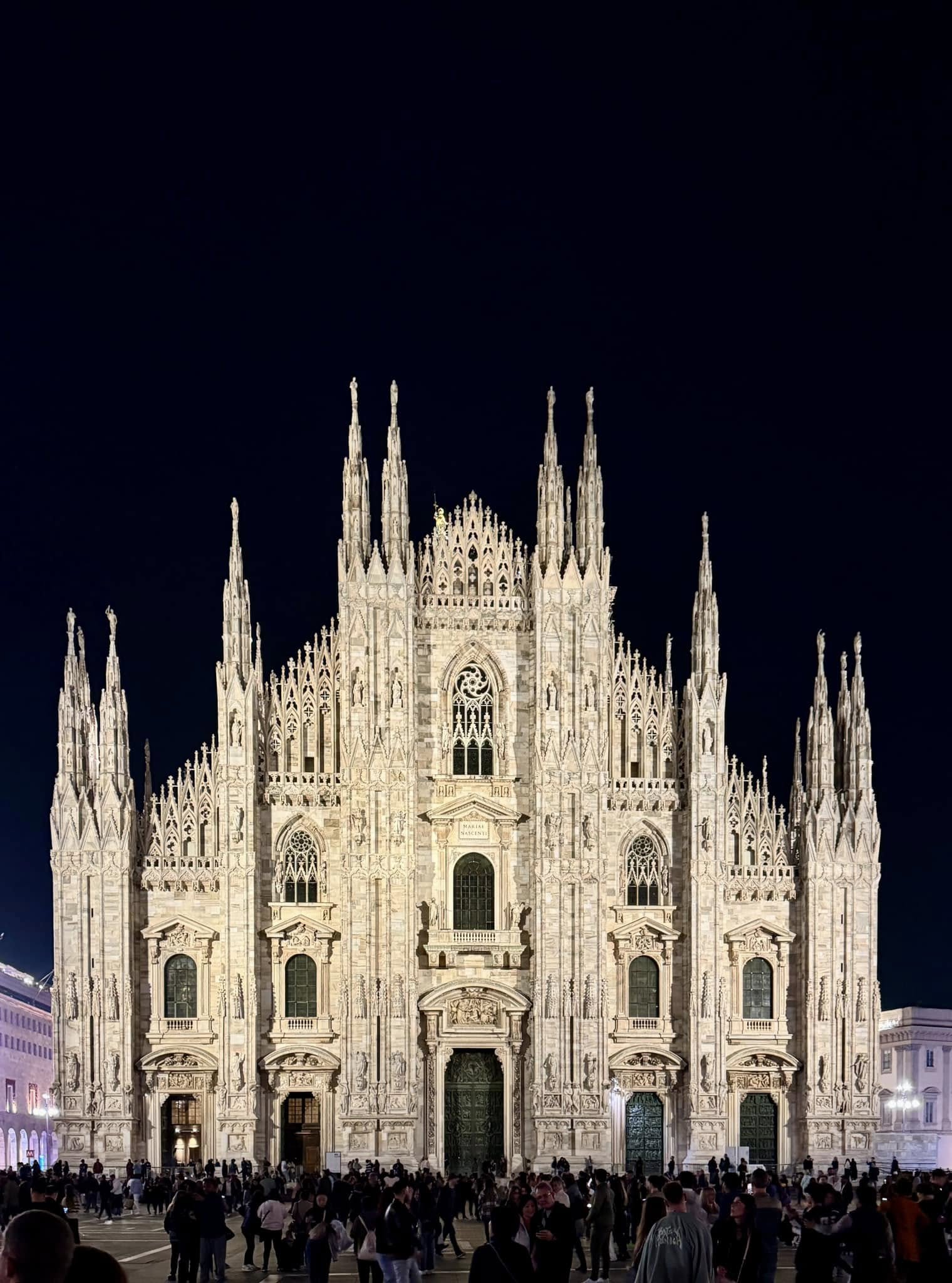
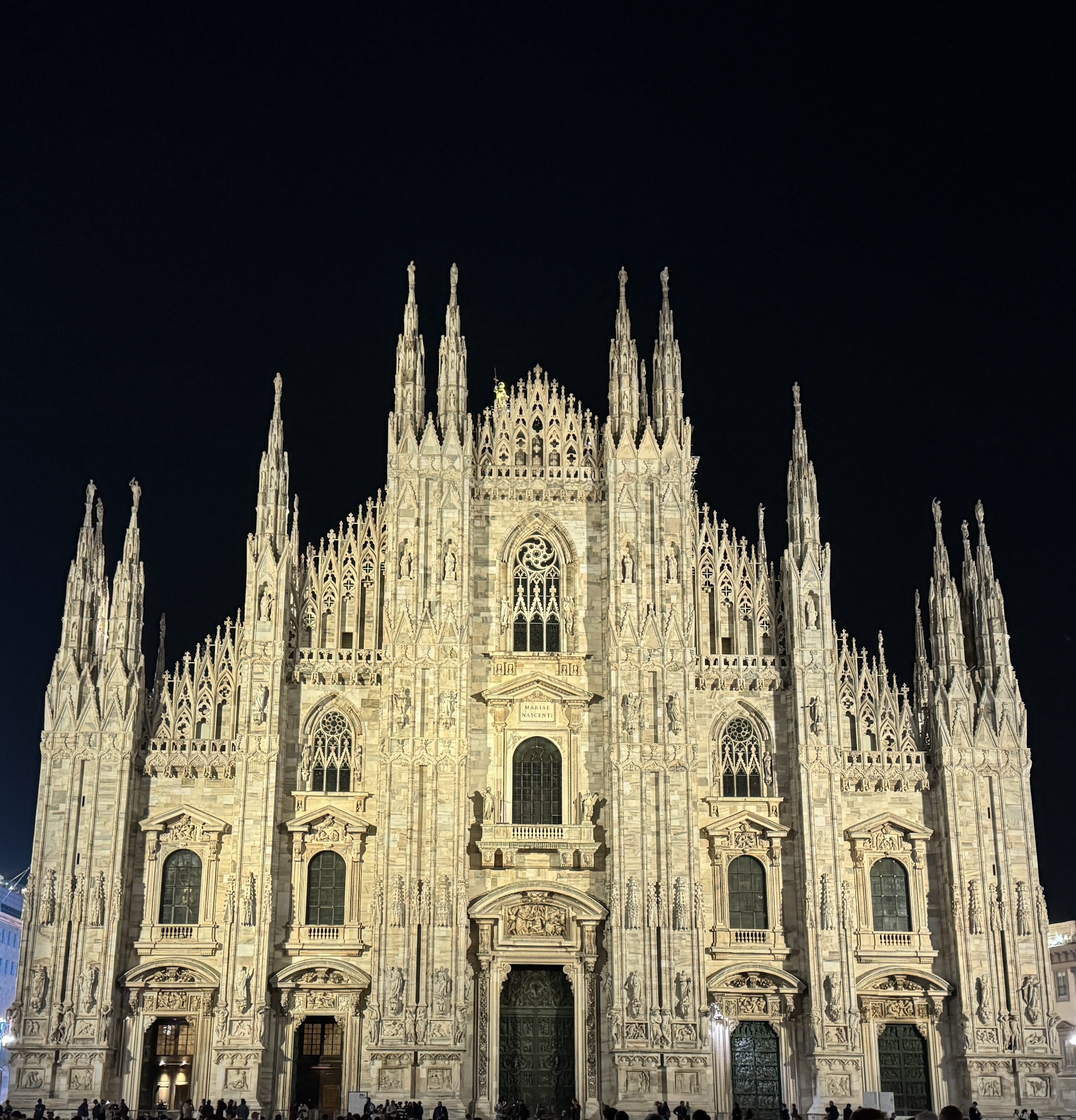
Milan’s Duomo is one of the most remarkable buildings I’ve seen. Equally remarkable is the fact that it officially took nearly 600 years to build it (they started in 1386 and the official completion date was 1965)! But like any construction project, it’s never done. There is constant restorative work going on, whether it’s fixing interior details or the ongoing replacement of the soft marble of the terraces. Needless to say, it keeps a lot of people employed.
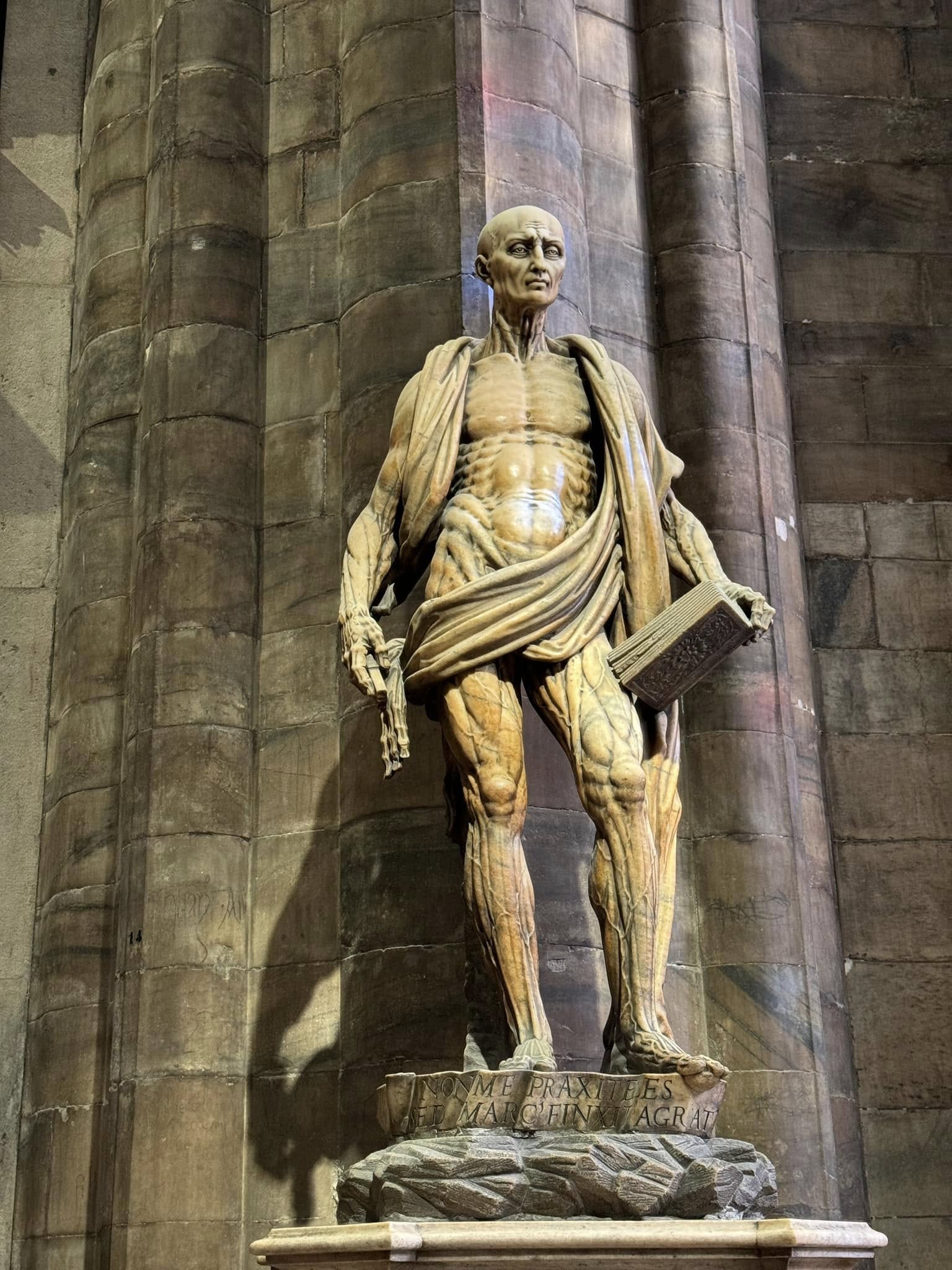
Lots of surprising and unusual features inside the Duomo. This is Saint Bartholomew, one of the 12 apostles and a martyr who was said to be skinned alive and beheaded for his great success in converting the Armenian King Polymius, his family and 12 entire cities. He stands here with his muscles and nerves exposed in amazing anatomical detail, his skin draped over his shoulders like a cloak. The sculptor, Marco d’Agrate signed his 1562 piece “Non me Praxiteles, sed Marcus finxit Agrates,” meaning “Not Praxiteles, but Marco d’Agrate created me”, comparing his skill to that of the renowned Ancient Greek sculptor. Pretty cheeky for those days!
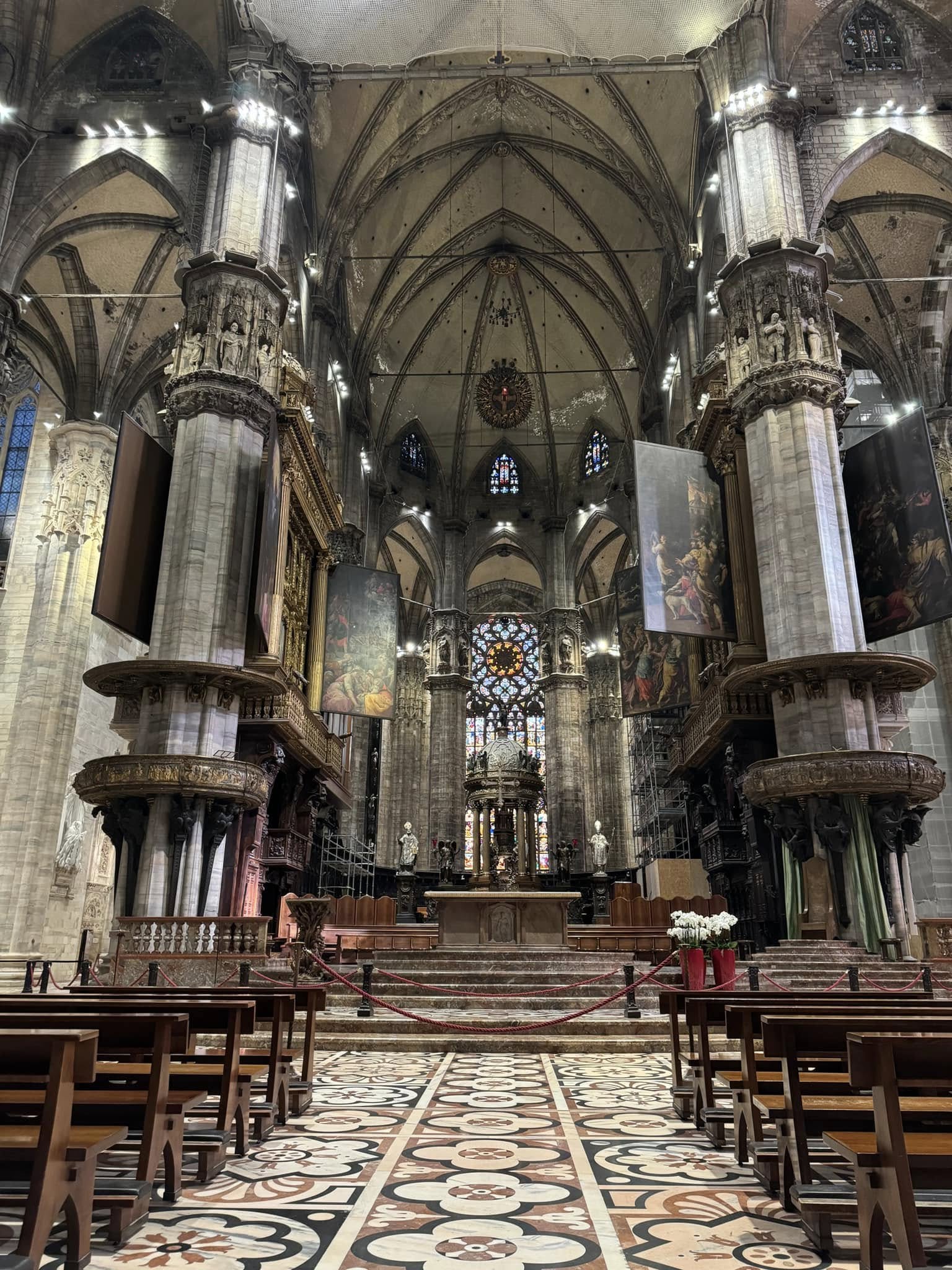
Forty-five metres above the altar, can you see a tiny red light in a cross above the top window in the centre? Zoom in on the photo. That’s where the most precious relic in the Duomo is: a holy nail from Jesus’ cross.
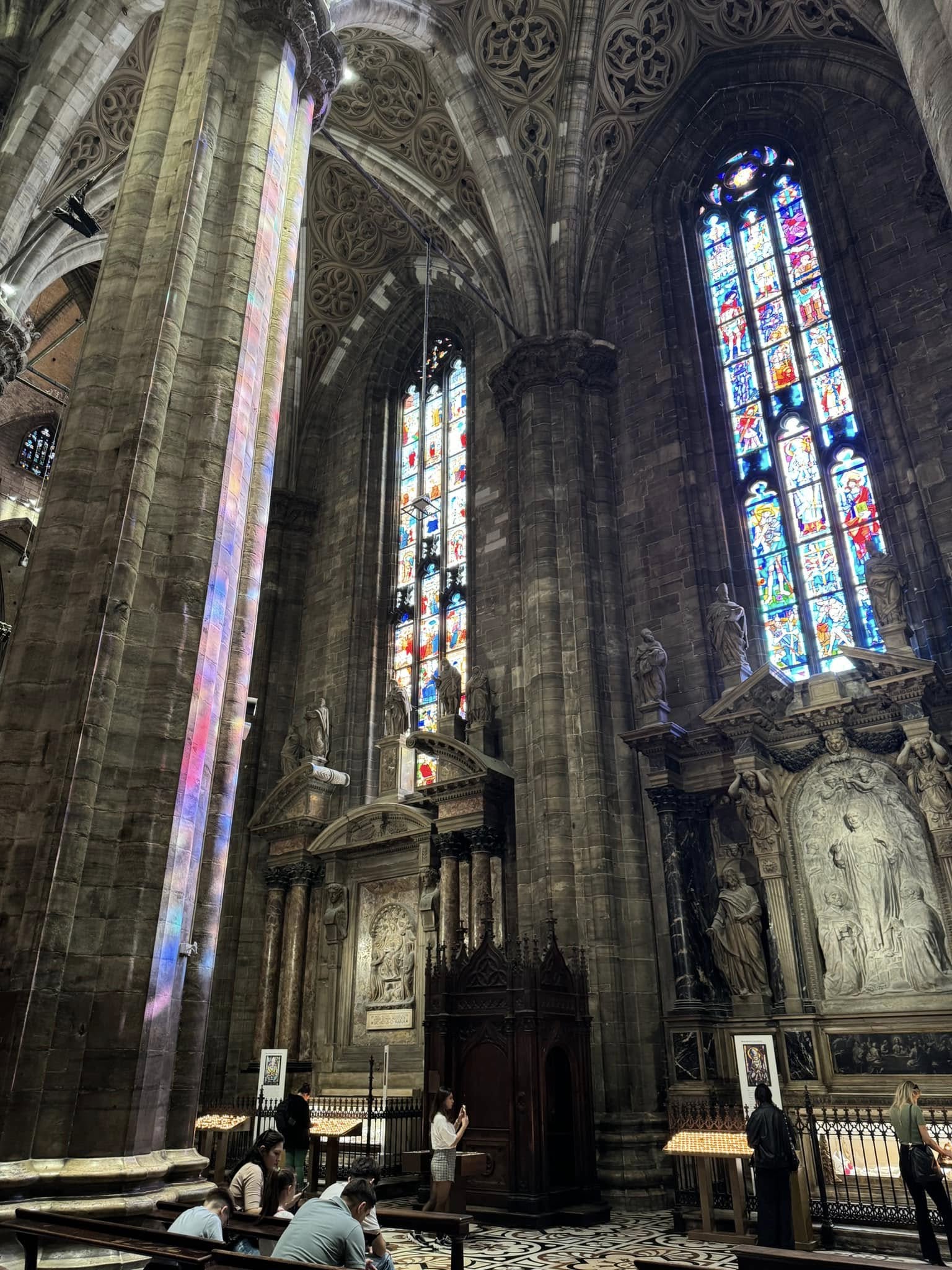
At just the right angle of the sun outside, the colours explode on some of the 52 pillars inside the Duomo. The fact that there is one pillar per week of the year is no coincidence. It was a little trick in medieval times to blend time, spirituality and continuity. I guess in those rough and tumble times, people needed to trust that something solid was always going to be there for them.
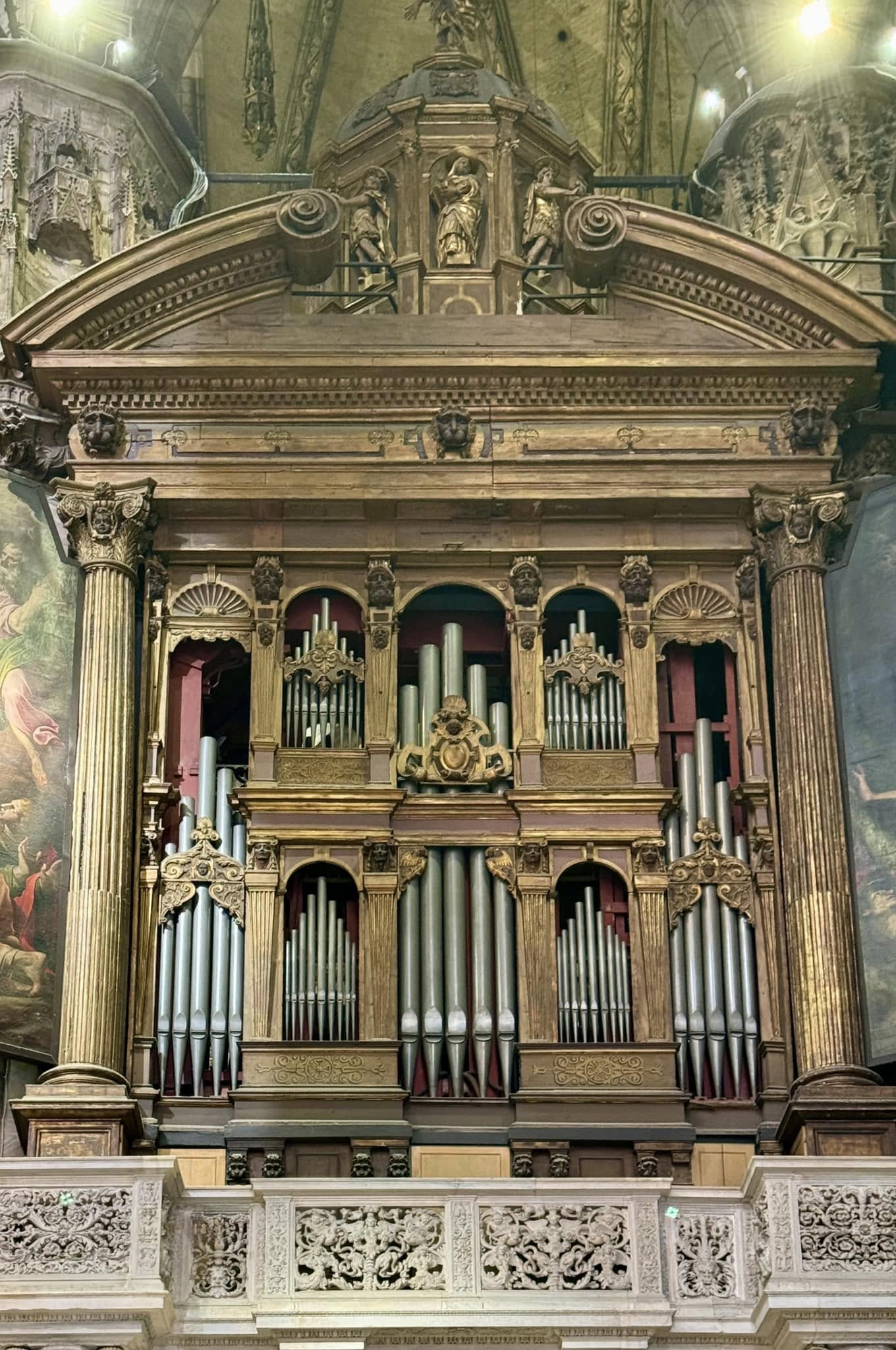
The organ inside the Duomo is the largest in Italy and second largest in Europe with 15,800 pipes and 120 registers. This is only half of it. With its other half, the two sides flank the altar. Sadly it wasn’t playing while we were there. It must have an incredible sound reverberating around this giant stone place!
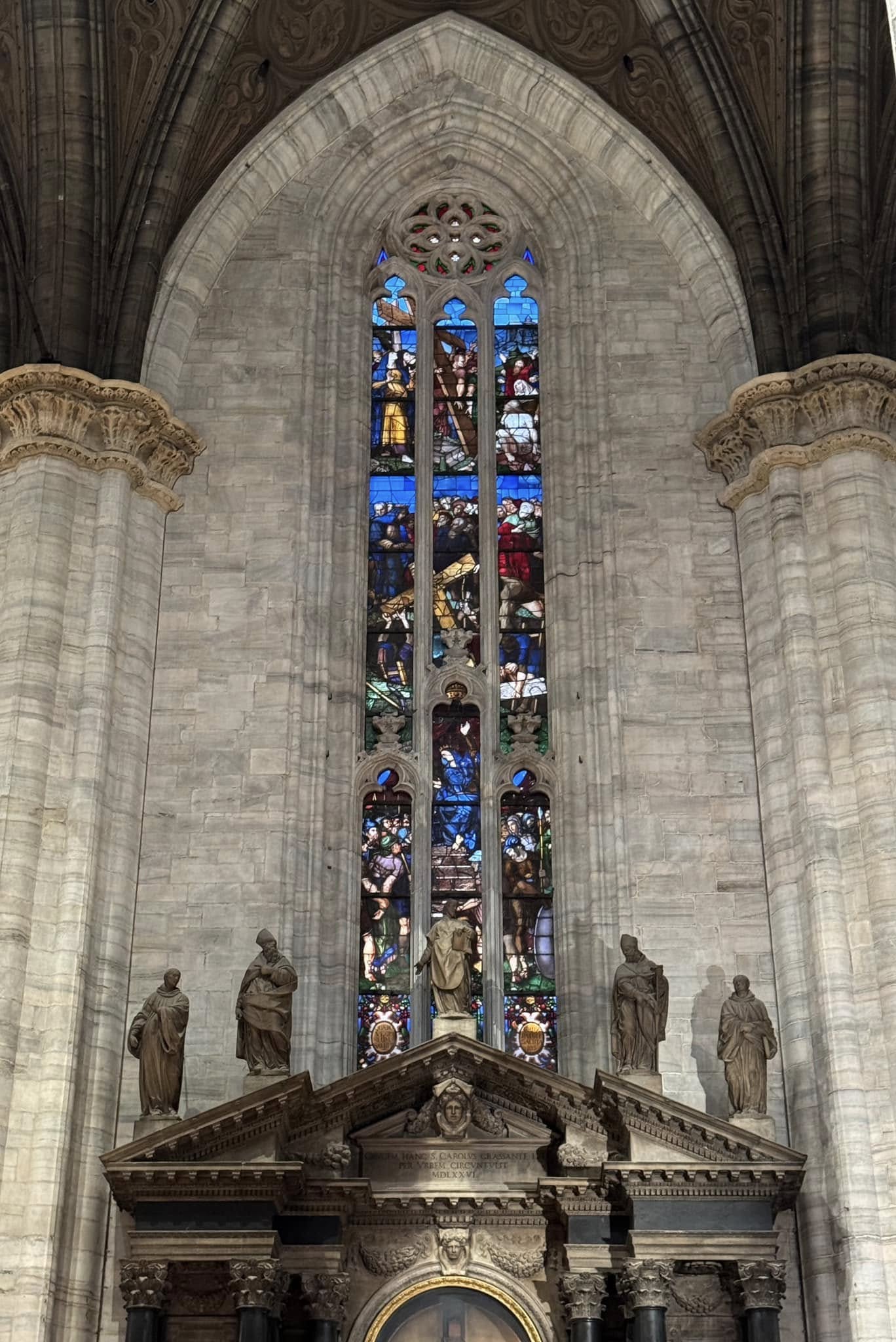
Notice all the yellow and gold tones in this stained glass window (one of 164 stained glass windows in the Duomo). There’s a story…of course! During the making of the windows, there was a young man nicknamed Zafferano (saffron) whose job it was to mix precisely the right amount of saffron into the glass to produce just the right hue of yellows and golds. One day, he was angry at his boss (you can imagine how mistreated the workers would have been) and dumped some saffron into the risotto served at his boss’s daughter’s wedding banquet. Imagine the surprise at receiving a plate of yellow risotto when you’re expecting the only thing they knew…white rice! The birth of the classic Risotto Milanese. The guests loved it and I guess Zafferano didn’t get into trouble. Another fun (true?) food origin story comes from the same time as the Duomo was being built (but for something that took six centuries to build, I guess most stories from Milan came from the time the Duomo was being built!) is the story of Panettone. Legend goes that in the lead-up to Christmas in 1495, the Sforza’s main chef burned the dessert. His assistant Tony saved the day by crafting something from the leftover, unburned dough (flour, eggs and sugar) and candied fruit. The guests at the Christmas party loved it and when the Duke asked for an explanation for the change in menu, the chef said “it’s Tony’s bread”…pan di Tony…panettone.
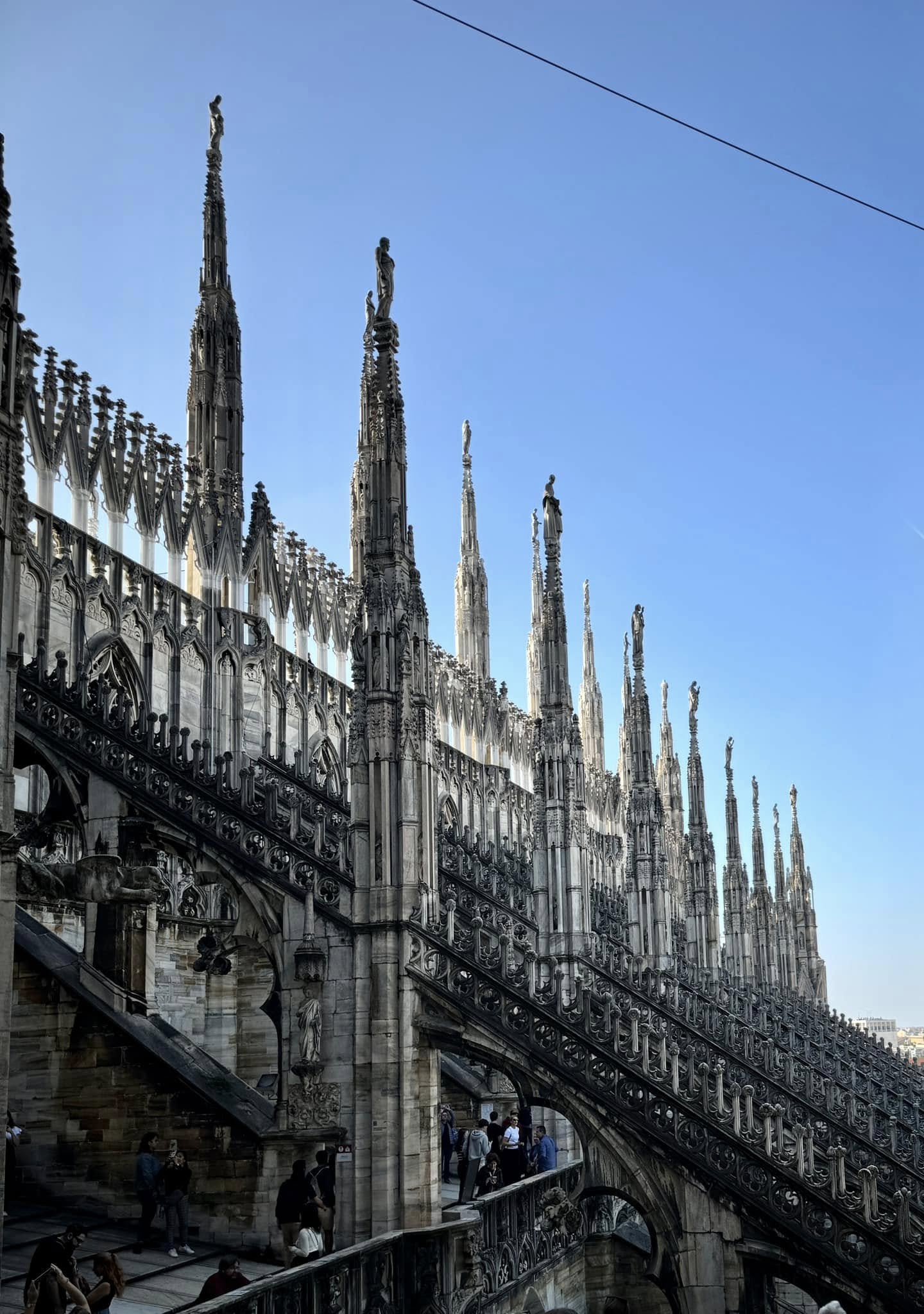
Now onto the rooftop! This was spectacular but not something I’d want to do in the rain; the wet marble would be treacherous! But to be walking among 135 unique marble spires and thousands of statues reaching into the blue sky was magical. The variation in the colour of the marble is interesting and the source of much employment! The Duomo is made of Candoglia marble from Lago Maggiore. It is fairly soft and over time goes from white to grey to black as it suffers from pollutants in the air. It reaches a point where it crumbles and needs to be replaced, hence the employment! So the white we see is relatively recently replaced and the grey to black is next on the docket.
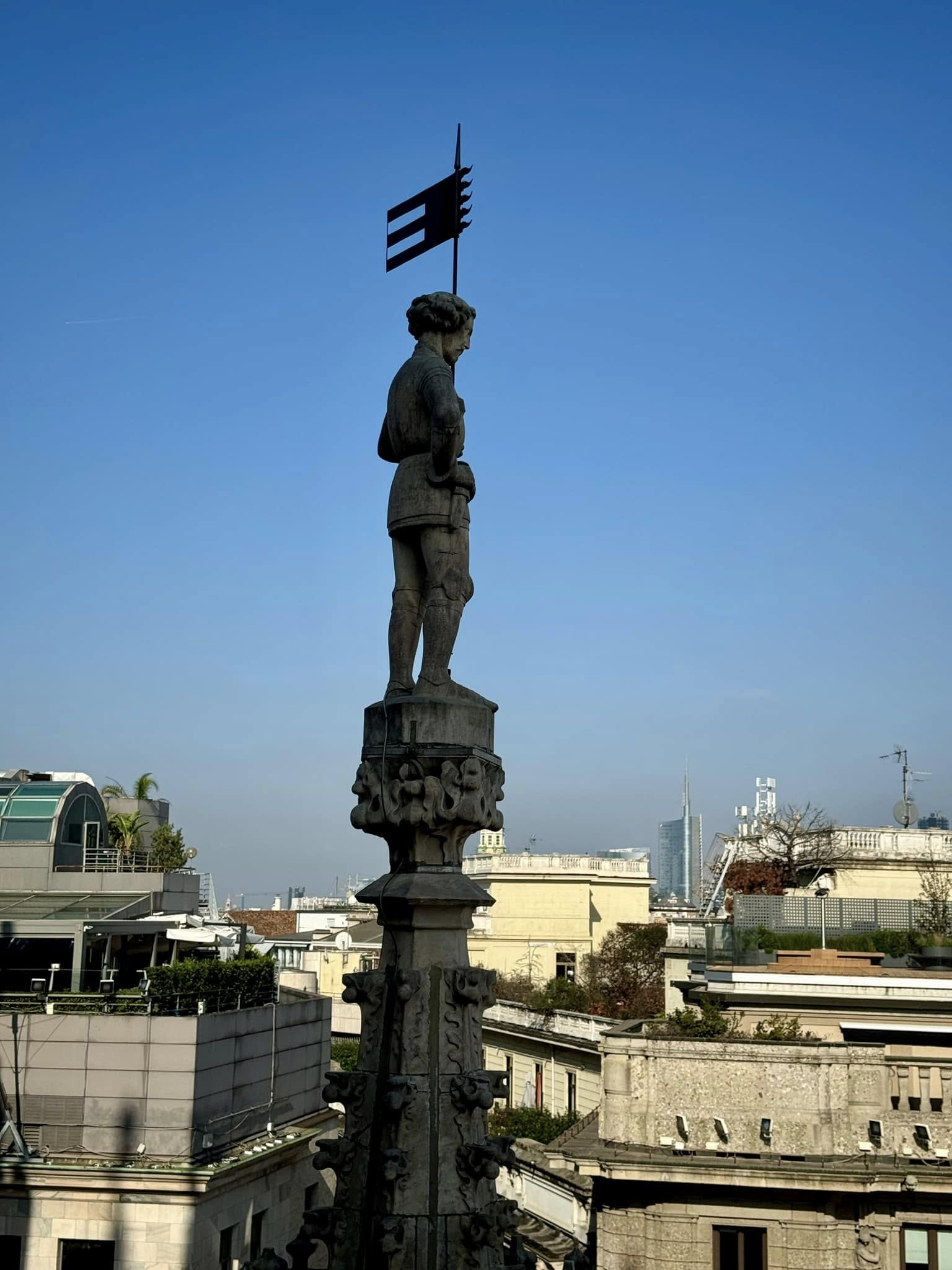
The Carelli spire was the first one on the Duomo, and a big naming opportunity. Upon his death, Marco Carelli, a big deal merchant in Milan, donated 35,000 gold ducats (the equivalent of about €30,000 today) part of which was used to build the Carelli spire in 1395. Saint George stands on top and was given the face of Gian Galeazzo Visconti, Milan’s first Duke (his granddaughter married into the Sforza family when the Dukedom shifted).
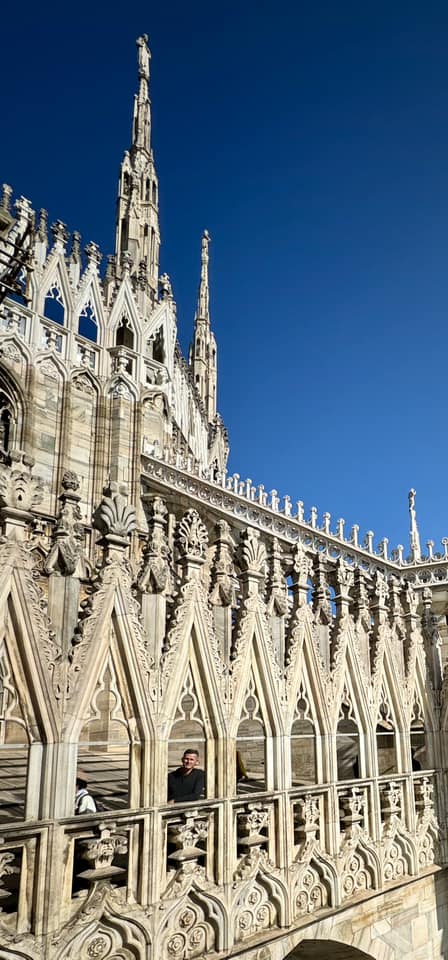
The falconatura (marble triangles named after the bird of prey) on all the edges give the building a delicate, lace-like appearance.
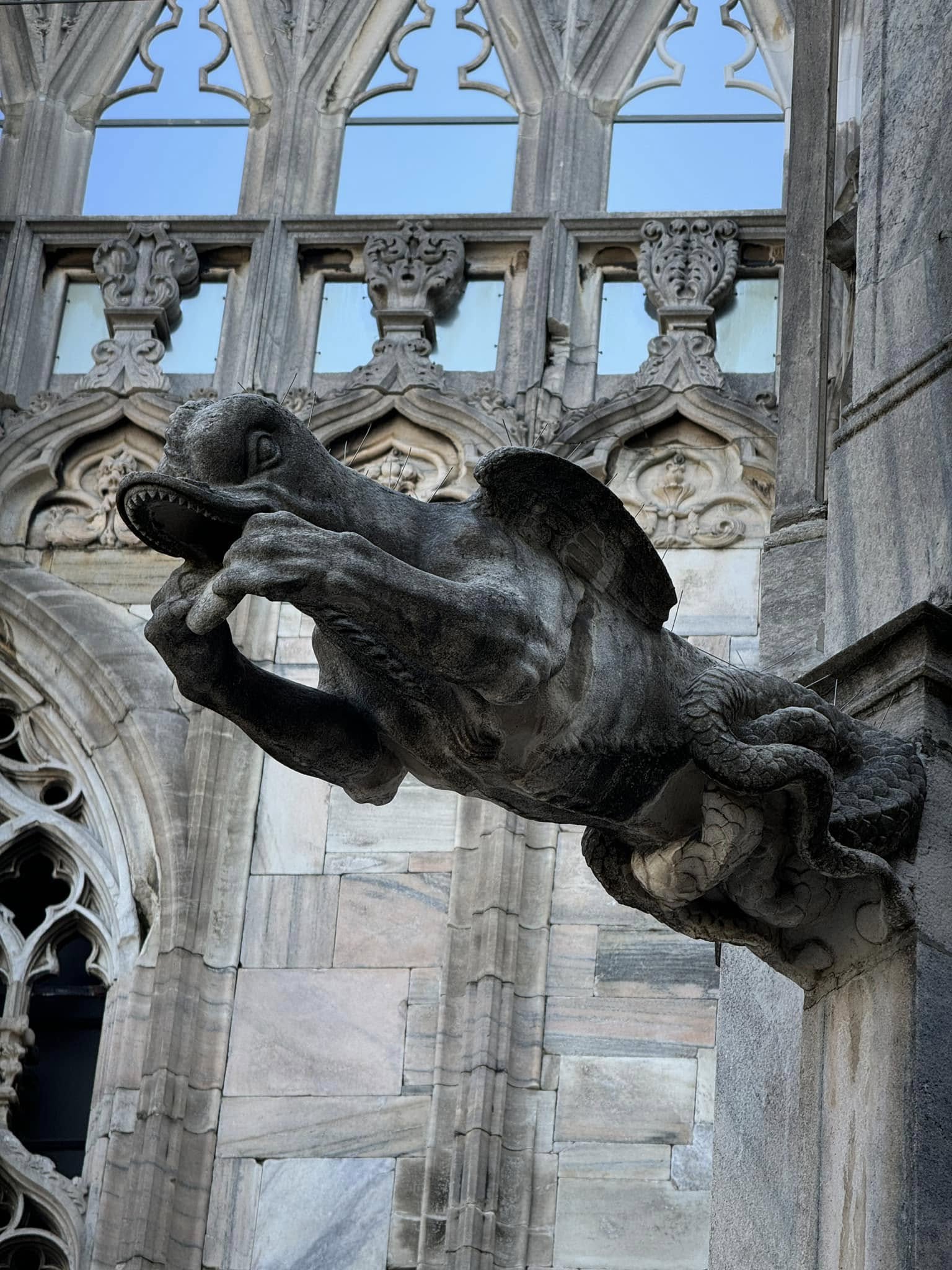
As funky and scary looking as gargoyles may appear, they serve an important function as the end of the drainage system. How fun to be up here in a rainstorm and watch the water flowing out of their mouths. One hundred and fifty of them help channel the water off the building.
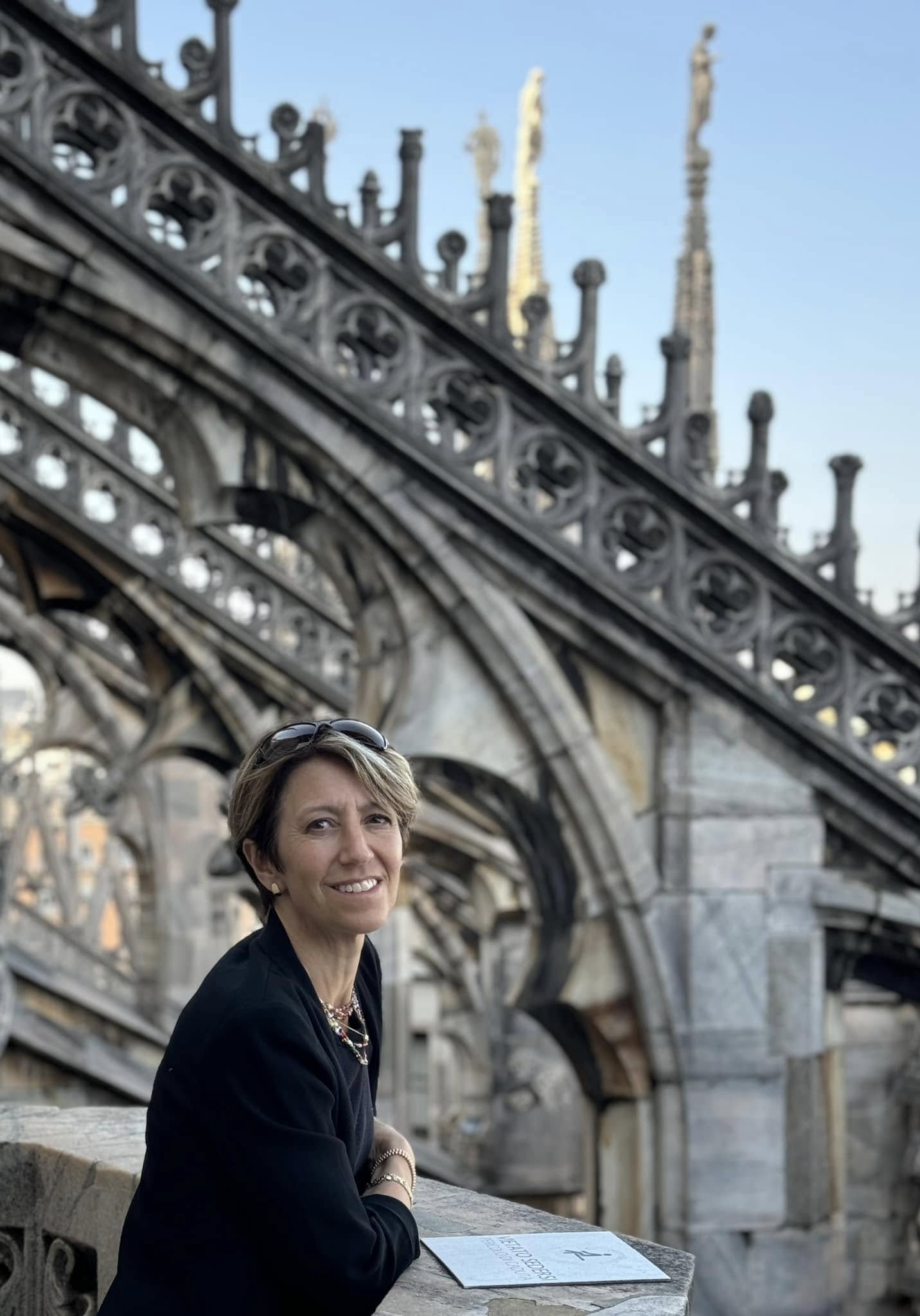
Thankfully the flying buttresses are helping to hold up the roof otherwise I might tumble from my perch!
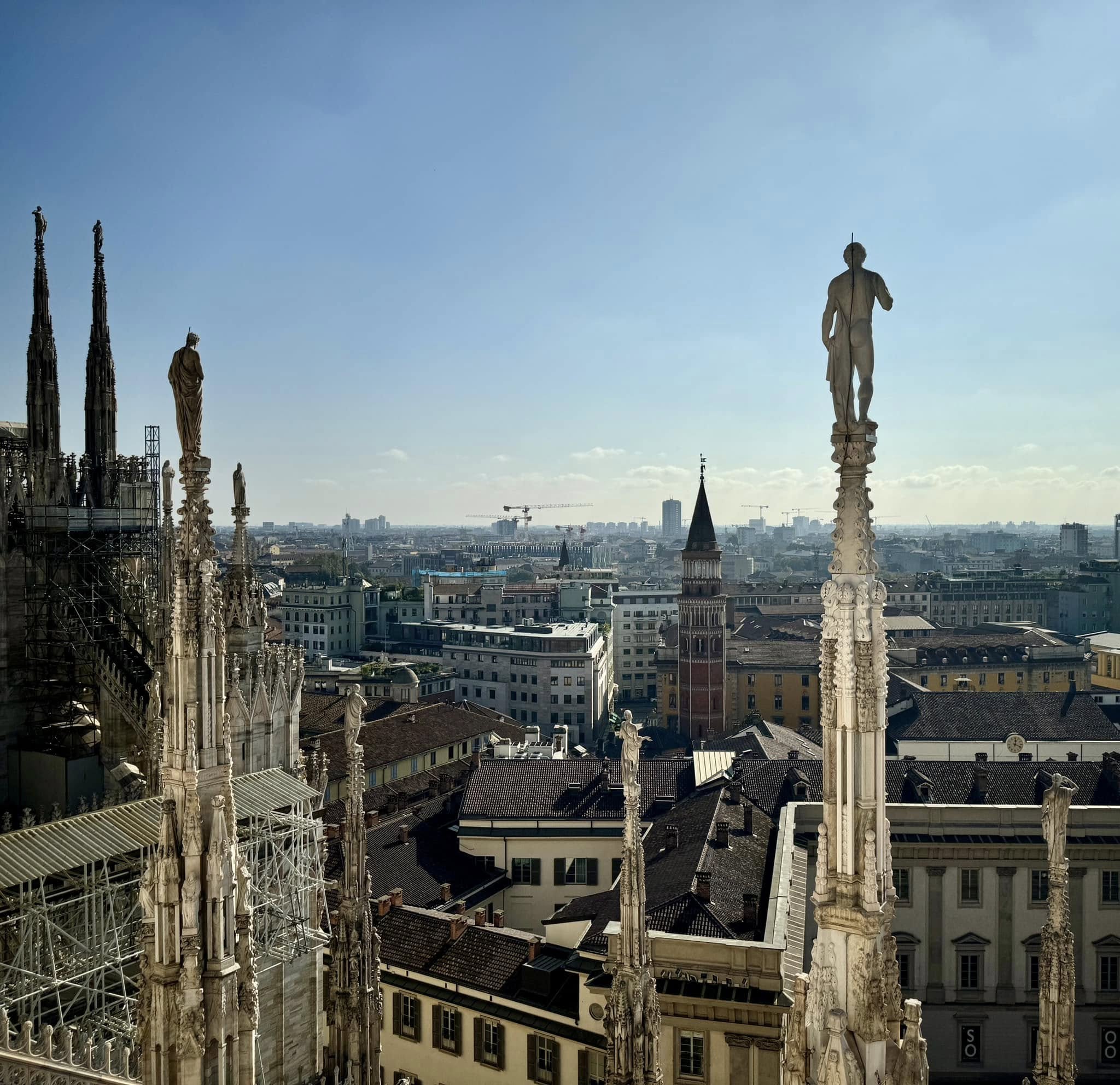
What a view! Given the cranes in the distance, maybe work is slowing on the Duomo and people are available to build some new stuff.
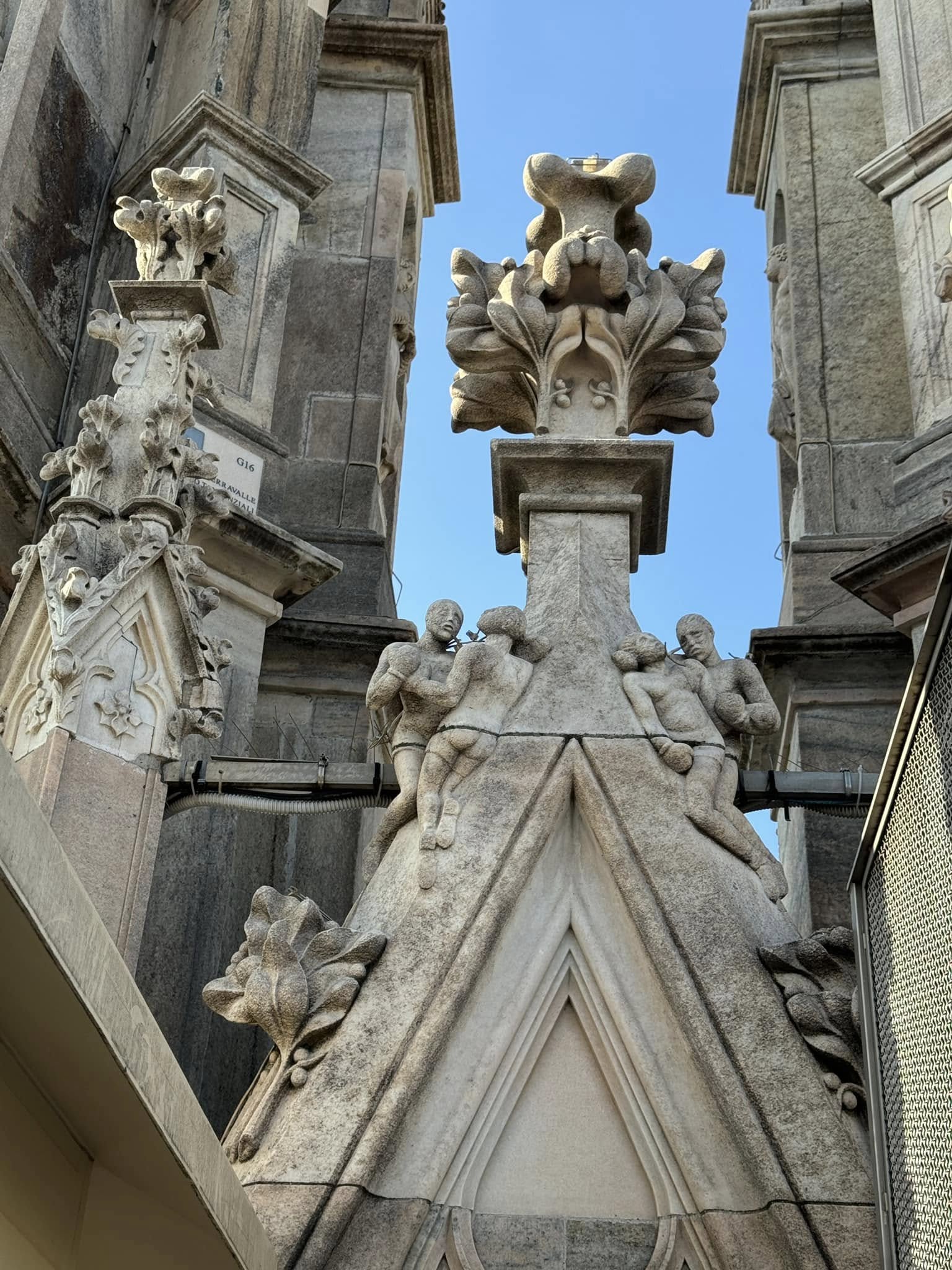
The stonemasons had some creative freedom and some fun. There are surprising little treasures sprinkled around like this collection of boxers. They were carved in the 1930s as an homage to Primo Carnera, an Italian boxing legend of the time and world heavyweight champion from 1933-1934.
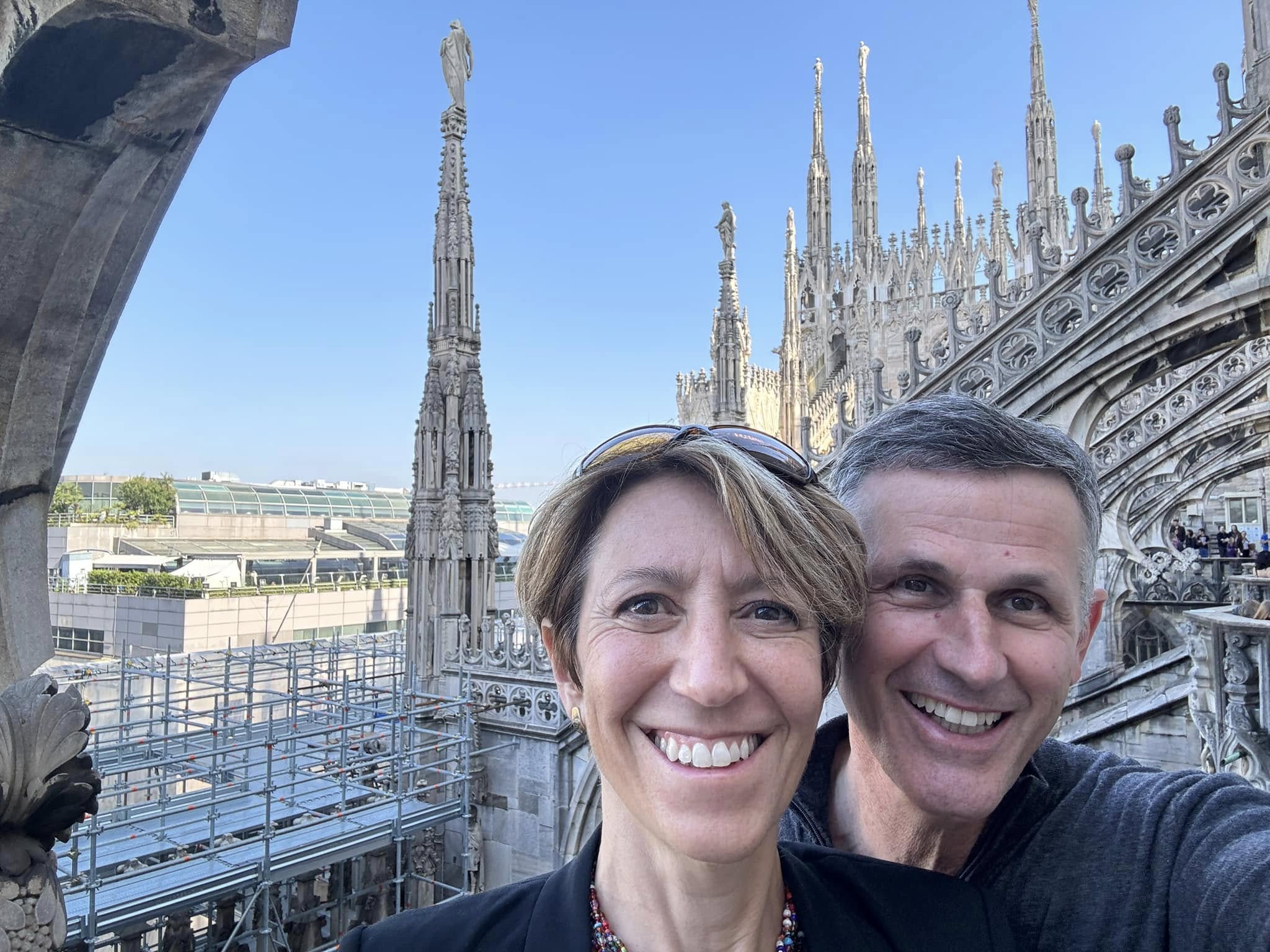
Spectacular day in a spectacular place!
We were walking down a street one evening and noticed a lineup of people outside a beautiful, historic building (turns out it was the Palazzo Delle Poste). We thought it would be a nice place for aperitivo…until we realized it was a Starbucks!! So we avoided it.
Late at night with no lineup, we decided to see what all the fuss was about. I have to admit it was worth the visit! Turns out it was one of Starbucks’ premier Reserve Roasteries, opened in 2018 when Starbucks dared to enter Italy. This is one of six reserve roasteries in the world (in addition to Chicago, New York, Seattle, Milan, Shanghai, Tokyo). From here they roast 1,000 kg per day which they ship all over Europe and the Middle East.
The space is pretty cool and for Adam, who doesn’t appreciate the fashion side of Milan, he loved the manufacturing process here!
The beans are roasted and then shoot through pipes where they cool and are stored in a big tank for 7 days. Then they either get bagged for shipment or shoot through twisty pipes and dump right into the grinders for brewing here…espresso, pour over, siphon and cold brew, not to mention the alcohol additions not typically found in the average Starbucks!